
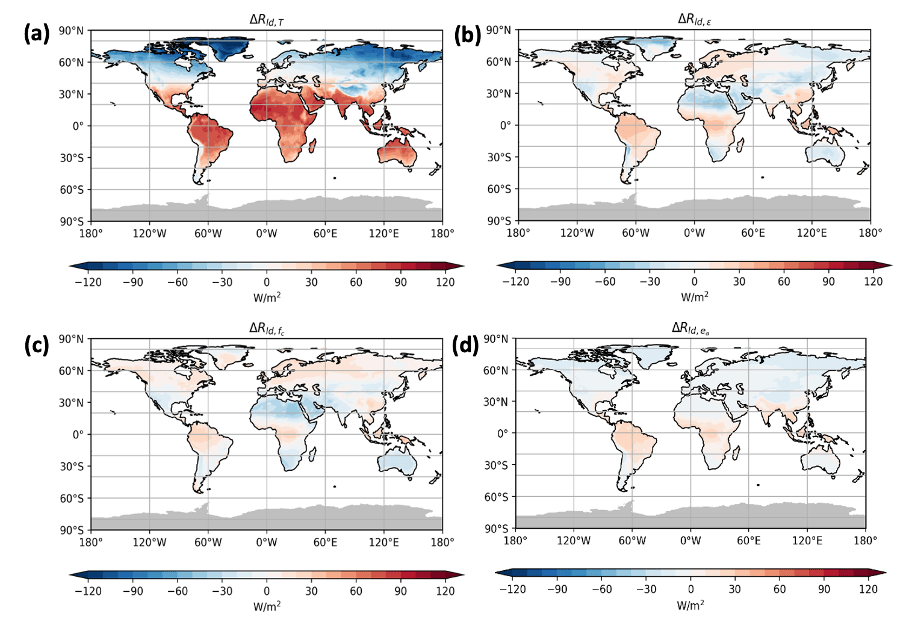
Downwelling longwave radiation dominantly heats the Earth’s surface across the globe and shows systematic variations in space and time. In our new paper, we showed that these variations are predominantly shaped by changes in the heat accumulation within the lower atmosphere, while changes in cloud-cover and water-vapor remain a secondary contributor.
Downwelling longwave radiation is a dominant term in the surface energy balance which contributes more than twice as much energy as absorbed solar radiation. It holds a central role in global warming, representing the greenhouse effect, heating the Earth surface across the globe and playing a key role in shaping surface temperatures. It is mainly influenced by how absorptive the atmosphere is (which depends on presence of water vapour, clouds and greenhouse gases) and how warm the atmosphere is (which depends on heat stored in the atmosphere). So, how much do these factors affect the variations in downwelling longwave radiation in space and time?
We address this question in our new paper just published in Earth System Dynamics led by Yinglin Tian. We used a semi-empirical parameterization of downwelling longwave radiation from Brutsaert (1975). The elegance of this parameterization is that it has a physical interpretation and links the flux to an effective emissivity of the atmosphere, mostly affected by water vapor and clouds – using the extension from Crawford and Duchon (1999) – and air temperature. With this, we can then identify why the flux of downwelling longwave radiation varies with season and across regions. It is worth noting that these parameterizations do not explicitly consider changes in downwelling longwave flux due to increasing CO2 concentrations. As a result, we utilize these equations to analyse regional, inter-seasonal, and diurnal variabilities in downwelling longwave radiation in the climatological mean state, but not its long-term trends.
We first evaluated this approach against modern datasets to find that it works really well. We then showed that one can use these equations to decompose this flux into different components, and relate changes to differences in cloud cover, water vapor, and atmospheric heat storage. We found that most changes in downwelling longwave radiation are caused by differences in atmospheric heat storage that are reflected in differences in air temperature (see Figure). These alterations in heat storage result from the accumulation of heat in the lower atmosphere, a process that varies across regions and time periods. For instance, sunlight during the day warms the surface, and the surface in turn heats the lower atmosphere, causing an increase in its heat content and subsequently in downwelling longwave radiation. As a result, temperatures in the late afternoon are warmer than in the early morning, even when the solar radiation values are identical.
Why is this useful? These equations have a number of applications. One can use them to understand why global warming results in a stronger temperature response on sunny days, which we have already used in the past (see this Du et al., 2020), or in understanding differences in longwave downwelling radiation during the wet and dry season in the Amazon basin (Conte et al., 2019). They can also be used to interpret why temperatures vary across dry and humid regions and periods (see our Ghausi et al., 2023, which uses this). They can be used to quantify the individual contributions by the advection of heat and moisture during extreme temperature events (see Tian et al., 2023). Additionally, it also has potential to be used for the gap-filling of downwelling longwave radiation in observational data with a strong physical foundation.
References:
- Brutsaert, W., 1975: On a derivable formula for long-wave radiation from clear skies. Water Resources Research, 11, 742-744.
- Tian, Y., Zhong, D., Ghausi, S. A., Wang, G., and Kleidon, A.: Understanding variations in downwelling longwave radiation using Brutsaert’s equation, Earth Syst. Dynam., 14, 1363–1374, https://doi.org/10.5194/esd-14-1363-2023, 2023.
- Conte, L., Renner, M., Brando, P., Oliveira dos Santos, C., Silverio, D., Kolle, O., Trumbore, S. E., Kleidon, A., 2019: Effects of Tropical Deforestation on Surface Energy Balance Partitioning in Southeastern Amazonia Estimated From Maximum Convective Power. Geophysical Research Letters, 46(8), 4396-4403.
- Crawford, T. M., and C. E. Duchon, 1999: An Improved Parameterization for Estimating Effective Atmospheric Emissivity for Use in Calculating Daytime Downwelling Longwave Radiation. Journal of Applied Meteorology, 38, 474-480.
- Ghausi, S. A., Tian, Y., Zehe, E., & Kleidon, A. (2023). Radiative controls by clouds and thermodynamics shape surface temperatures and turbulent fluxes over land. Proceedings of the National Academy of Sciences, 120(29), e2220400120.
- Tian, Y., Ghausi, S. A., Zhang, Y., Zhang, M., Xie, D., Cao, Y., … & Kleidon, A. (2023). Radiation as the dominant cause of high-temperature extremes on the eastern Tibetan Plateau. Environmental Research Letters, 18(7), 074007.
- Du, M., Kleidon, A., Sun, F., Renner, M., & Liu, W. (2020). Stronger global warming on nonrainy days in observations from China. Journal of Geophysical Research: Atmospheres, 125(10), e2019JD031792.

 Earthsystem.org