What can we learn from entropy about life on Earth? In this series of videos, I aim to provide the thermodynamic and Earth system background to answer this question. The videos are based on two lectures that I gave in Padova in July 2025. I split the lectures up into an introduction, six questions, and a summary, each in a separate video. This blogpost provides a brief description of the different videos, references for further reading, and the links.
Continue reading “Thermodynamics of the Biosphere: A short series of videos”Tag: Earth System Science
Neu auf Youtube: Was ist dran an der Gaia Hypothese?
Im neuen Video auf Youtube geht es um die Gaia Hypothese, die James Lovelock in den 1970er Jahren formuliert hat. Sie postuliert, dass Leben die planetare Umwelt so verändert und reguliert, dass sie optimal für das Leben ist. Wenn man die Biosphäre als thermodynamisches System betrachtet, welches mit der Erde stark interagiert und dabei ihre Leistung maximiert, ist diese Hypothese gar nicht so abwegig. Mehr Hintergrund in diesem Blogpost.
Continue reading “Neu auf Youtube: Was ist dran an der Gaia Hypothese?”Neu auf youtube und als Terra-X Kolumne: internationale Trends in der Stromerzeugung zeigen klar, was die Zukunftstechnologien sind – Photovoltaik und Wind!
In der gegenwärtigen Energiedebatte wird viel behauptet – Kernenergie soll wieder auferstehen, China setzt ja eh auf Kohle und Deutschland ginge einen Sonderweg. Ein nüchterner Blick auf Stromerzeugung im internationalen Vergleich zeigt klar: Deutschland geht keinen Sonderweg, sondern ist Vorreiter. Mehr dazu in der Terra-X Kolumne mit Harald Lesch und als Youtube Video. Und demnächst als Artikel in Physik in unserer Zeit.
Touring India 2025: A short course in Roorkee, and visits with talks in Gandhinagar, Bombay, and Pune to discuss and interact on entropy and the powers of the Earth system
We were back in India, spending a week at the IIT Roorkee to teach a short course on the Second Law in the Earth System Science, giving talks and having discussions at IIT Gandhinagar, IIT Bombay, IISER Pune and IITM. Find out more on what we did and discussed, look at a few photos, and some related papers in this blogpost.
New PhD position: Using Energy and Optimality to Unearth the Secrets of Soil
Soil might not seem like the flashiest player in the Earth system, but make no mistake – beneath its humble surface lies a complex and dynamic world. It is a critical component of our planet, cycling carbon and nutrients, supporting life, and shaping ecosystems. My research group jointly with colleagues from the Soil Biogeochemistry group at the Max Planck Institute for Biogeochemistry, we are embarking on an exciting new journey: applying thermodynamic principles to soils to better understand their processes, dynamics, and limits. And we are looking for a curious mind to join us as a PhD researcher! More infos in this blogpost.
Continue reading “New PhD position: Using Energy and Optimality to Unearth the Secrets of Soil”New paper: Towards better, simpler, and physically-based estimates of regional wind resource potentials – Testing our KEBA approach with simulations for Kansas
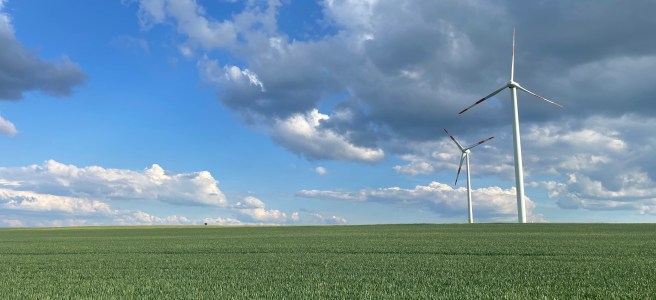
Wind turbines generate electricity by removing kinetic energy from the winds – after all, that is what they are designed to do. The more wind turbines are deployed within a region, the more the wind speeds must be reduced, thereby impacting the wind resource potential of the region. In our new paper we tested our KEBA approach with much more complex numerical weather simulations and found that accounting for the removal of kinetic energy captures the dominant effect, but one also needs to distinguish between daytime and nighttime conditions. This removal effect lowers the resource potential of Kansas by more than 60%, but still yields substantial amounts of electricity – more than Germany currently consumes. More infos in the blogpost and in the paper.
Continue reading “New paper: Towards better, simpler, and physically-based estimates of regional wind resource potentials – Testing our KEBA approach with simulations for Kansas”New Paper: The Second Law of Thermodynamics, Life and Earth‘s Planetary Machinery Revisited
About 15 years ago I published a paper on “Life, hierarchy, and the thermodynamic machinery of planet Earth”. This paper was quite influential for me as it clarified many things about how the second law of thermodynamics applies to the Earth system. It led to quite a few applications of thermodynamic limits in climate science and renewable energy that worked really well and that I found insightful because it allows us to do climate science in a simple yet physically-based way. The follow-up paper just published provides a summary of this approach and explores potential, more concrete applications of how the biosphere optimizes its form and functioning, and on life on Earth and beyond in general.
Continue reading “New Paper: The Second Law of Thermodynamics, Life and Earth‘s Planetary Machinery Revisited”Workshop on dissipative Earth systems in Firenze in September 2024 … or how the Second Law connects power and dissipation with distributions, structures and information in Earth systems.
The interesting parts of the Earth system are those that perform work, show dynamics, build and maintain structures, deplete gradients, dissipate and produce entropy – in short, dissipative systems. These dissipative systems operate far from the boring state of thermodynamic equilibrium and show interesting behavior, such as well formed structures and power-law scaling. A good topic for a short intro course, because it is one of the lesser known aspects of Earth systems, and a good occasion to meet and talk about. That‘s what we‘ll do in September at the University of Florence in Italy. And to make the topic not quite about everything on Earth, we will focus on hydrogeosystems.
Continue reading “Workshop on dissipative Earth systems in Firenze in September 2024 … or how the Second Law connects power and dissipation with distributions, structures and information in Earth systems.”New paper: Working at the limit – how entropy, work and limits shape Earth system functioning. Here is a simple, but long summary of the key points.
Entropy has intrigued me for a long time – it usually comes up at the very end of asking “why” questions. It is such a fundamental concept in physics, but then – why does nobody talk about it in Earth system science? My review paper just published in Earth System Dynamics explains why entropy is so essential to understand the dynamics of the Earth system: because it limits how much work can be done, and work is at the very core of what we call dynamics.
Continue reading “New paper: Working at the limit – how entropy, work and limits shape Earth system functioning. Here is a simple, but long summary of the key points.”New Book Chapter: Understanding the Earth as a Whole System: From the Gaia Hypothesis to Thermodynamic Optimality and Human Societies
“The whole is more than the sum of its parts” – this has been said by smart people throughout human history, from Aristotle to Gibbs. But how does it apply to the vastly complex Earth system? In the book chapter just published I describe how this focus on the whole combined with a thermodynamic formulation of the Earth system including life helps us to understand that the whole is more, and simpler, than the sum of its parts. This is because complex, natural systems appear to work at their thermodynamic limit. The emergent functioning may then very well share characteristics similar to those postulated by the controversial Gaia hypothesis of James Lovelock, which states that life regulates the Earth for its own benefit.
Continue reading “New Book Chapter: Understanding the Earth as a Whole System: From the Gaia Hypothesis to Thermodynamic Optimality and Human Societies”We’ll be at #EGU22, showing how radiation and maximum power shape temperatures, their extremes, the atmospheric circulation and the wind energy resource. @akleidon @s_ghausi @yinglin_tian
Corona is still around, also in Vienna, but the EGU General Assembly will nevertheless happen again, in a hybrid form. We are thrilled to be there physically, giving our 6 minute short talks on our work, and look forward to seeing and talking to you there!
Continue reading “We’ll be at #EGU22, showing how radiation and maximum power shape temperatures, their extremes, the atmospheric circulation and the wind energy resource. @akleidon @s_ghausi @yinglin_tian”Solar radiation is the main cause for diurnal variations on land. Looking at this slightly differently than how it is normally done helps to better understand observations and evaluate models of the land surface
My former postdoc, Maik Renner, just got his paper published in the Journal of Hydrometeorology, in which he evaluated the performance of common land surface models at the diurnal time scale using FluxNet observations. The evaluation was based on a simple concept that we developed in my group: that solar radiation is the main driver of the diurnal variation of variables that characterize the land-atmosphere system. This sounds trivial. Of course solar radiation is the dominant driver, so what novel insights can be gained from this view? Continue reading “Solar radiation is the main cause for diurnal variations on land. Looking at this slightly differently than how it is normally done helps to better understand observations and evaluate models of the land surface”