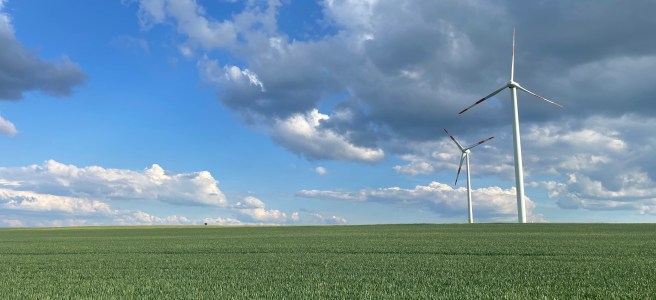
Wind turbines generate electricity by removing kinetic energy from the winds – after all, that is what they are designed to do. The more wind turbines are deployed within a region, the more the wind speeds must be reduced, thereby impacting the wind resource potential of the region. In our new paper we tested our KEBA approach with much more complex numerical weather simulations and found that accounting for the removal of kinetic energy captures the dominant effect, but one also needs to distinguish between daytime and nighttime conditions. This removal effect lowers the resource potential of Kansas by more than 60%, but still yields substantial amounts of electricity – more than Germany currently consumes. More infos in the blogpost and in the paper.
Continue reading “New paper: Towards better, simpler, and physically-based estimates of regional wind resource potentials – Testing our KEBA approach with simulations for Kansas”Tag: wind energy
New Paper: Estimating #offshore #windpower in the German bight. It describes the depletion effects of the #windenergy resource and its implications for the 70 GW target in an accessible way, based on our Agora Energiewende study. https://doi.org/10.1002/piuz.202201654 https://export.arxiv.org/pdf/2301.01043
Offshore wind energy is rapidly growing, but what happens when more and more wind turbines deplete the regional wind energy resource?
Continue reading “New Paper: Estimating #offshore #windpower in the German bight. It describes the depletion effects of the #windenergy resource and its implications for the 70 GW target in an accessible way, based on our Agora Energiewende study. https://doi.org/10.1002/piuz.202201654 https://export.arxiv.org/pdf/2301.01043”We’ll be at #EGU22, showing how radiation and maximum power shape temperatures, their extremes, the atmospheric circulation and the wind energy resource. @akleidon @s_ghausi @yinglin_tian
Corona is still around, also in Vienna, but the EGU General Assembly will nevertheless happen again, in a hybrid form. We are thrilled to be there physically, giving our 6 minute short talks on our work, and look forward to seeing and talking to you there!
Continue reading “We’ll be at #EGU22, showing how radiation and maximum power shape temperatures, their extremes, the atmospheric circulation and the wind energy resource. @akleidon @s_ghausi @yinglin_tian”Why does wind energy become less efficient when used at larger scales? Basic physics explains this effect, starting with a very limited ability of the atmosphere to generate wind energy from radiation, as described in my new review just published.
Wind energy plays an important role in the transition to a carbon-neutral, sustainable energy system and is rapidly expanding. So it is a good time to ask how much wind energy there actually is, whether we get close to the limits anytime soon, and why the efficiency of wind energy must decline when used at larger scales. These are basic science questions: How, and why, does the atmosphere actually generate motion, how much does it generate, and how much of it can at most be used? These questions I address in a review paper just published in which I show that it does not take much physics to answer these.
Continue reading “Why does wind energy become less efficient when used at larger scales? Basic physics explains this effect, starting with a very limited ability of the atmosphere to generate wind energy from radiation, as described in my new review just published.”