
Combustion engines, gas boilers, coal-fired power stations: all these technologies are based on combustion. Physics clearly shows that this is not efficient. We have known for a long time how to do it better. Here the translated (and illustrated) version of my Terra-X blogpost.

The mastery of fire has made many things possible for humankind and made life easier: gas stoves, combustion engines and central heating. In Germany, this progress has brought us enormous economic prosperity. But now we are about to take the next step in development: away from combustion and towards electricity, because it is much more energy efficient.
Technologies evolve towards greater efficiency
This development towards greater efficiency can already be seen in the way we produce light. A long time ago, combustion was also used here. Candles burn wax. The rising soot particles are so hot that they lose some of their heat through the emission of visible light. But only a small part of the energy becomes light, most of it becomes heat. Pretty inefficient.
Then came the light bulb. It uses electricity, so no combustion here. The filament gets hotter than the soot particles. So more of the energy is emitted as visible light. A lot of heat is still generated, but it is already more efficient than the candle.
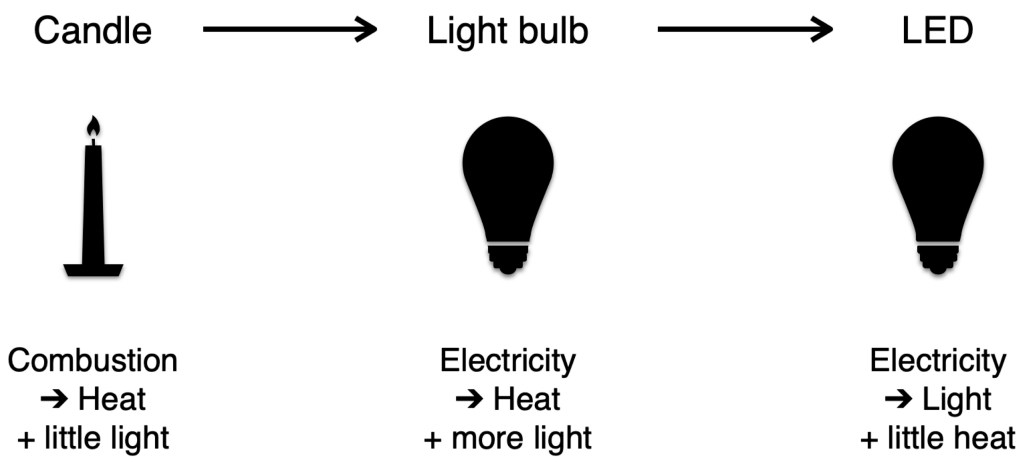
Today we use LEDs. They also use electricity, but generate practically no heat. This is possible because they use a phenomenon of quantum physics and only emit the wavelengths in the visible range that we want. This makes them unbeatably efficient.
We can see a physical trend towards greater efficiency: away from combustion and towards electricity. We will also see the same development in other technologies: in electricity generation, mobility and how we generate room heating and hot water.
Combustion causes a lot of loss
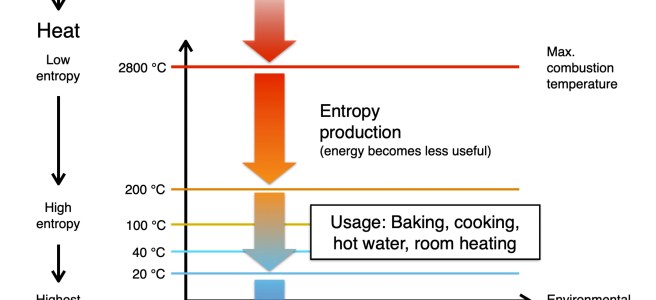
Why are combustion-based technologies so inefficient? Fuels actually contain a lot of usable energy. Theoretically, you could reach very high temperatures of several thousand degrees when burning them. But to heat living spaces, we only need a room temperature of just over 20 degrees Celsius. The temperature difference between the theoretical maximum combustion temperature and the room temperature therefore remains unused. It is wasted.
The same waste occurs in other combustion processes. We do not need several thousand degrees for cooking and baking, and power plants and combustion engines cannot technically use these high temperatures. Technologies based on combustion are therefore always associated with unavoidable losses and are therefore inefficient. The keyword here is entropy (see also note below).

Electric technology is more efficient
Electricity is much more efficient. Heat pumps heat living spaces by simply creating a temperature difference between inside and outside – just like in a refrigerator. In this way, they avoid the high temperatures of combustion and the associated losses.
Electromobility avoids the losses inherent in the combustion engine. This electrification has long since happened on the railways.
Photovoltaics, which is unbeatable in terms of efficiency, is booming in electricity generation.
And there is further potential for efficiency: heat pumps can use even less electricity by better insulating houses. And if less mass is moved per person in urban traffic, huge amounts of energy can also be saved here.

The energy transition is modernization
By using these modern technologies, Germany could easily reduce its primary energy consumption by more than half. The energy transition is therefore not an ideology, but the consistent use of more energy-efficient technologies that avoid combustion.
Of course, it requires a huge effort. We need to restructure our energy system and modernize industry, which still relies heavily on combustion technologies. It will also take strength to move forward against the strong headwinds blowing against us from the lobbying of oil companies and authoritarian countries such as Russia and the Middle East, which place their profits above physics.
However, the energy transition is inevitable. Ultimately, we are following a development that is dictated by physics and that humans have always followed.
A note at the end
I translated this version because it concerns my favorite topic entropy, and because it has a really important implication for the energy transition, putting it on basic physics. The text is more or less identical from the original in German, with only minor edits for readability.
But there is one more thing I would like to add, and it concerns entropy. It makes the above reasoning more quantitative. The inefficiency of combustion-based technologies basically relates to the fact that in principle, combustion could produce heat with very low entropy. Think Clausius‘ expression of entropy, being heat added by the temperature by which it has been added. But for many of our uses, we only need high entropy heat (i.e., low temperature heat, e.g., for cooking or room heating). So the energy transition is not just about sustainable energy generation, it is also about efficiency of its consumption. And efficiency is ultimately linked to the second law of thermodynamics.
Reference
The original text appeared on the Terra-X Blog in German can be found here.

 Earthsystem.org