
The interesting parts of the Earth system are those that perform work, show dynamics, build and maintain structures, deplete gradients, dissipate and produce entropy – in short, dissipative systems. These dissipative systems operate far from the boring state of thermodynamic equilibrium and show interesting behavior, such as well formed structures and power-law scaling. A good topic for a short intro course, because it is one of the lesser known aspects of Earth systems, and a good occasion to meet and talk about. That‘s what we‘ll do in September at the University of Florence in Italy. And to make the topic not quite about everything on Earth, we will focus on hydrogeosystems.
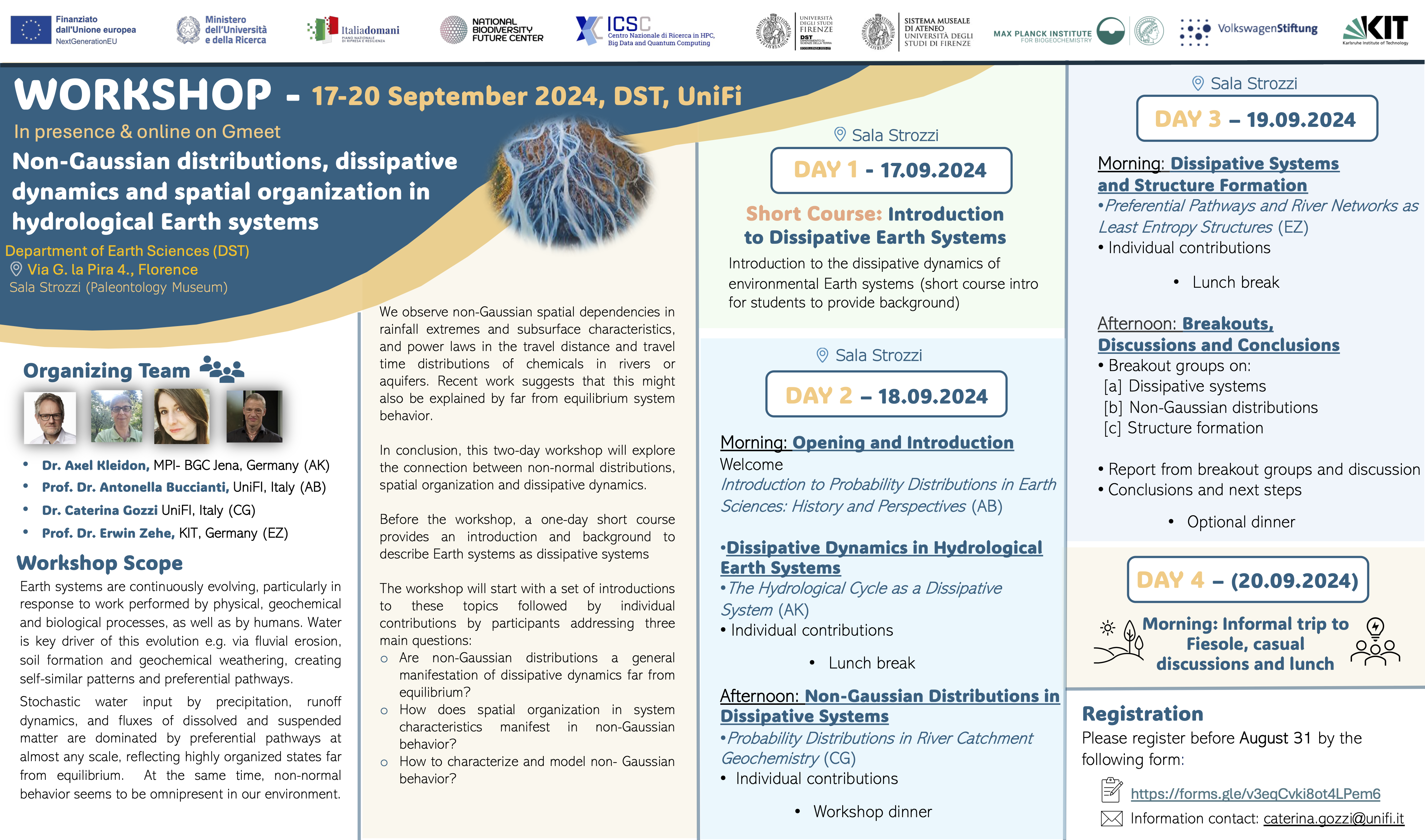
The event will take place on 17 – 20 September 2024 in the Department of Geosciences of the University of Florence near the Piazza San Marco in central Firenze in Italy. It is jointly organized by Antonella Buccianti (geochemist), Caterina Gozzi (geochemist), Erwin Zehe (hydrologist) and Axel Kleidon (environmental physicist).
Overview
The programme starts on 17 September 2024 with a short course on the basics of dissipative Earth systems. The course is aimed at a general level to provide some basics to those who are interested but do not have the background in non-equilibrium thermodynamics and how it applies to Earth systems (not to worry, the thermodynamics part won‘t be scary!).
The next two days, 18 – 19 September 2024, provide the time for talks and discussions. The talks are distributed among three parts: (i) dissipative dynamics; (ii) non-Gaussian distributions, and (iii) structure formation. Each part will contain a general introduction to the topic. After the presentations we will spend some time in break-out groups to discuss the presentations and come back to formulate some conclusions and next steps.
We hope that these two days will inspire future work. To provide more time for informal discussions, we plan to have a joint informal trip on 20 September 2024, visit the ancient Roman theatre there, enjoy life and further discussions.
Registration
To take part, either as participant or as speaker, you need to register here. You can also submit a title and short abstract there if you want to present, but you do not have to. Online participation is also possible, but for talks, we decided that we want those live in the audience to better interact with speakers.
Please register (and submit) by 31 August 2024.
Programme
The programme with the talks will be distributed after the deadline in early September when we know how many submissions we have received and how we can best accommodate anyone who is interested and has something to say.
Questions
Ask Caterina or Axel about details.
A subjective and incomplete list of references of our own work
Kleidon, A.; Gozzi, C.; Buccianti, A.; Sauro Graziano, R.: Type of probability distribution reflects how close mixing dynamics in river chemistry are to thermodynamic equilibrium. Science of the Total Environment 941, 173409 (2024)
Zehe, E.; Loritz, R.; Jackisch, C.; Westhoff, M.; Kleidon, A.; Blume, T.; Hassler, S. K.; Savenije, H. H.: Energy states of soil water – a thermodynamic perspective on soil water dynamics and storage-controlled streamflow generation in different landscapes. Hydrology and Earth System Sciences 23 (2), S. 971 – 987 (2019)
Kleidon, A.: Thermodynamic Foundations of the Earth system. Cambridge University Press (2016)
Zehe, E.; Ehret, U.; Pfister, L.; Blume, T.; Schroeder, B.; Westhoff, M.; Jackisch, C.; Schymanski, S. J.; Weiler, M.; Schulz, K. et al.: HESS Opinions: From response units to functional units: a thermodynamic reinterpretation of the HRU concept to link spatial organization and functioning of intermediate scale catchments. Hydrology and Earth System Sciences 18(11), S. 4635 – 4655 (2014)
Kleidon, A.; Renner, M.: Thermodynamic limits of hydrologic cycling within the Earth system: concepts, estimates and implications. Hydrology and Earth System Sciences 17 (7), S. 2873 – 2892 (2013)
Zehe, E.; Blume, T.; Kleidon, A.; Ehret, U.; Scherer, U.; Westhoff, M.: A thermodynamic approach to link self-organization, preferential flow and rainfall–runoff behaviour. Hydrology and Earth System Sciences 17 (11), S. 4297 – 4322 (2013)
Kleidon, A.; Zehe, E.; Ehret, U.; Scherer, U.: Thermodynamics, maximum power, and the dynamics of preferential river flow structures at the continental scale. Hydrology and Earth System Sciences 17, S. 225 – 251 (2013)
Kleidon, A.: How does the Earth system generate and maintain thermodynamic disequilibrium and what does it imply for the future of the planet? Philosophical Transactions of the Royal Society of London – Series A: Mathematical Physical and Engineering Sciences 370 (1962), S. 1012 – 1040 (2012)
Porada, P.; Kleidon, A.; Schymanski, S. J.: Entropy production of soil hydrological processes and its maximisation. Earth System Dynamics 2, S. 179 – 190 (2011)
Kleidon, A.: Life, hierarchy, and the thermodynamic machinery of planet Earth. Physics of Life Reviews 7 (4), S. 424 – 460 (2010)

 Earthsystem.org