

April is here, and geoscientists are once again heading to Vienna. Why? Because Europe’s largest Geoscience Union, EGU, is all set to convene for its General Assembly, EGU25, which take place from 27 April – 2 May 2025. We are thrilled to be there again and share our science. Our group will be contributing to three oral presentations by our PhD student Saurabh and postdocs Tejasvi and Sarosh.
Our group gives three talks on quite different topics, but all are connected because they use the same thermodynamic systems approach, with the surface energy balance being the starting point. Sarosh starts on Monday with his work on maximum temperatures, Tejasvi continues on Wednesday on biases in the Penman-Monteith estimate of potential evaporation, and Saurabh finishes on applying maximum power to infer temperature at different elevations.
Sarosh presents his talk in the Session CL4.4 – Land-Atmosphere Interactions on Monday, 28th April, 09:05–09:15 in Room F1. He will talk about “Identifying regional drivers of day-to-day variations and hot extremes in daily peak temperatures”. Daily peak temperatures are affected by a number of factors like sunlight, air movement, cloud cover, land-cover type and how dry or wet the ground is. So, which of these factors are responsible for those days that feel scorching hot across different regions?
Sarosh addresses this question using our thermodynamic framework where he focuses at how the incoming and outgoing energy is changing over the land, how heat builds up and is stored within the atmosphere during the day and how much the atmosphere cools by removing this heat. His findings? In humid tropical regions, day-to-day temperature swings are mostly about clouds blocking sunlight or water vapor trapping heat. But in drier regions and polar areas, moving air masses and stored heat play bigger roles. When it comes to hot extremes, the story changes: soil dryness and how efficiently the land releases heat become the key drivers, with air movement and radiation remaining secondary contributors. If you want to learn more about it, don’t miss his talk. You can also connect with him in EGU during the whole week and contact him here.
Tejasvi presents in the Session HS2.5.1 — Large Scale Hydrology on Wednesday, 30th April, 17:10–17:20 in Room 3.16/17. His talk on “Correcting overestimated potential evaporation from the Penman-Monteith equation during water-limited conditions” deals with a critical issue in hydrology and climate science: how do we estimate potential evaporation? While the widely used Penman-Monteith equation works well in many situations, it can significantly overestimate potential evaporation in water scarce regions and periods. Why? As it turns out, dryness of the land surface can directly influence the estimates generated by the Penman-Monteith equation because the equation uses vapor pressure deficit to estimate evaporation.
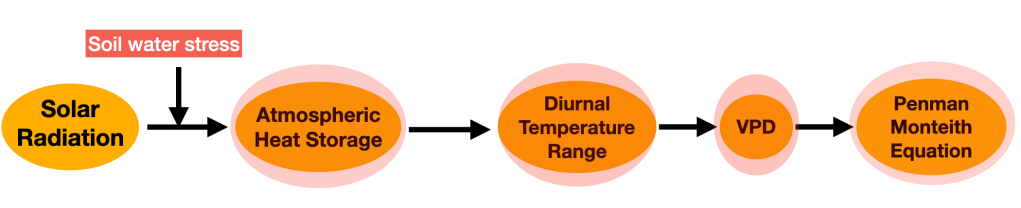
Tejasvi will show this using our thermodynamic systems framework. He starts with a surface energy balance perspective to understand the relationship of the vapor pressure deficit with the diurnal temperature range, which in turn reflect atmospheric heat storage variations (relating to Sarosh’s work). Tejasvi will discuss an analytical approach to infer these relationships and will show using observations that soil water limitation can inflate potential evaporation estimates. The Penman-Monteith equation can then generate evaporation rates requiring more energy than what is actually available at the surface. He then uses the approach to correct the Penman-Monteith equation, which leads to more realistic potential evaporation estimates in water-limited conditions, vital for accurate water resource management and for understanding how aridity is changing globally. Join his presentation to learn more about this work and its implications! Feel free to connect with him any time during EGU or contact him here.
Saurabh presents in Session CL2.1 – Earth radiation budget, radiative forcing and climate change on Thursday, 1st May, 15:20–15:30 in Room 0.14. His talk titled “Understanding altitudinal temperature variation using surface energy balance approach” is based on his ongoing PhD project. The main point of his talk will be to ask the question: What shapes the altitudinal temperature variation?
To investigate this question, Saurabh uses the surface energy balance. Also, since the energy flux data is sparse in the mountains, he evaluates additional thermodynamic constraints (maximum power principle) to describe altitudinal temperature variations. He shows that downwelling longwave radiation changes the most with elevation and is consistent with the lower temperatures at higher elevations. However, since surface temperature directly feeds back into the downwelling longwave, he uses the semi-empirical relationships of Brutsaert (1975) and Crawford and Duchon(1999) to delineate the effects of atmospheric absorptive mass (water vapor predominantly) and the temperature at which the atmosphere radiates back to the surface. This interpretation is consistent with some crucial effects of climate change, like elevation-dependent warming, its disproportionately large impact on daily minimum temperatures, and winter seasons. If you want to know more, come to his talk. Feel free to contact him (here) and connect for more discussions during the EGU week.
Axel and Shengjie, unfortunately, will not be at EGU this year.

 Earthsystem.org