Touring India 2026: Short courses/workshops/talks at Kanpur, Pune, and Bombay to discuss how many features of climate can be better understood with a little bit of more thermodynamicsโ€ฆ

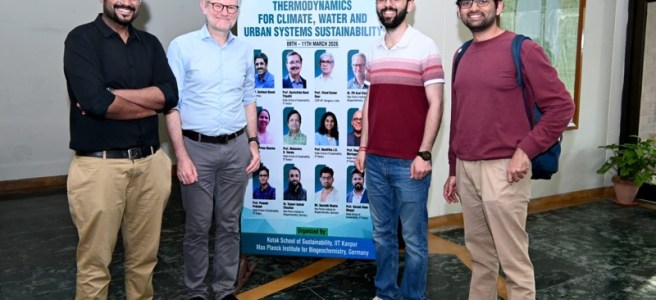
Again we were in India in March. This year, we visited Sarosh at IIT Kanpur with a short course on โ€œThermodynamics for Climate, Water, and Urban Systems sustainabilityโ€, discussed thermodynamics, maximum power, glaciers and climate change in Pune at IITM and IISER, and visited IIT Bombay for a workshop and seminar. And talked a lot with colleagues and students. More in this blogpost.


Our trip to India seems to become a habit. It started in 2019, when Vinod Gaur contacted me because of his and his colleagues interests in thermodynamics. Since 2023, we have come back once a year, meeting old friends and new people, having short courses, talking and discussing a lot, and seeing places along the way. And it certainly has a longer-lasting impact: I met both, Sarosh and Tejasvi, on my first trip, and now we do research together.

Stop 1: Short course at IIT Kanpur

Our first stop was at the IIT Kanpur in Northern India. This year we held a short course on โ€œThermodynamics for Climate, Water, and Urban Systems sustainabilityโ€ at the Kotak School of Sustainability at the IIT Kanpur. Sarosh, now a professor there, organised the event. We started with general session on thermodynamics, and then covered climate, water and human/urban systems. As in the last year, we had a mix of participants, some were internal students from Kanpur, some were external. Also the lectures were mixed to provide some differing views on the same topics and to discuss how these link together. For instance, this year we had some very nice and stimulating interactions with a social scientist, Pritee Sharma from IIT Indore, on sustainability. This course was similar to those we gave in previous years at IIT Roorkee and in Kashmir. And, as always, afterwards we looked at which parts worked well and which did not – this year, we planned for too little time to interact with students.

We then spend one day in Kanpur to have a bit of time to interact informally with Sarosh and his group – having time to think and scribble things on blackboards. In the evening, Indra Sen, a geochemist from IIT Kanpur, kindly took us out for dinner. He was the Master thesis advisor of Saurabh and Vani, who are both doing their PhDโ€™s in my group.

The weekend: Mughal architecture in Lucknow

On Friday, we went to the nearby city of Lucknow. This city has some Mughal architecture worth looking at, Vinod recommended it. He needed to leave on Saturday, so Saurabh and I first took him to the airport and used the time to talk, generally about life, the universe, and thermodynamics, and more concretely about how to spread the importance of thermodynamics more effectively.

In the afternoon Saurabh and I went to look at the Bara Imambara, a memorial and mosque built about 250 years ago. On top of the main building, there was a maze for defense – a rather fascinating construction! We were glad to take a guide, who explained some of the marvels of the architecture that we looked at – and who took us out of the maze! In the evening, it was very nice to meet the parents of Saurabh and have dinner together.

Stop 2: IITM Pune

On Sunday we continued our trip to Pune. We visited the Indian Institute for Tropical Meteorology (https://www.tropmet.res.in), IITM, and stayed in their guesthouse. We had three days of lectures, an event organized by IITM as a further education for their students. One afternoon we spent discussing with the work groups of the institute, on climate change, monsoon predictions and land-atmosphere interactions. As usual, it was as an intense period of lecturing and stimulating interactions.

The Thursday – well, that was a fault in our planning. As it happened, the Thursday was a public holiday in the state of Maharashtra, the New Year started. A good occasion to do a bit of sightseeing. So Tejasvi, Saurabh, Vijayan (a geophysicist who joined from Bangalore and talked about GPS and atmospheric water) and myself first went to a fort about 30 minutes away in the mountains, a place that I visited already in 2019. While we explored the fort, we again discussed a lot, about science, general things, and trying to explain what we saw – like rather green trees despite the dryness of the landscape.

For lunch, we returned to Pune, having lunch at a South Indian restaurant, eating dosas. I donโ€™t think I ate those before, and they were delicious. After the lunch, we went to another fort in downtown Pune while Saurabh was taken to the airport because he needed to leave earlier to Germany. The fort was niceโ€ฆ although I found the Banyam trees more fascinating to look at, especially from the top of the wall of the fort. We then visited a well-known Hindu temple. There, it was incredibly crowded because of New Year celebrations, but we managed to get a special treatment and received our blessing for the New Year. All of this happened at quite some hot temperatures in the mid-30ies, so quite perfectly we finished our sightseeing trip with wonderful ice cream.

On Friday we met Argha Banerjee from IISER Pune, which is just across the street from IITM, and interacted with him and his group. Tejasvi also gave a seminar in his department in the afternoon.

The weekend: Buddhist caves near Lonavala and downtown Bombay

On Saturday we then went to Lonavala, a town on the way to Mumbai that is at the Western Ghats – the coastal mountain range that stretches along the western coast of India. Before we came to the town, we visited two nearby sites with ancient Buddhist caves, both about 2000 years old. The first was, may be, less spectacular in terms of the main hall, but had such a nice, peaceful setting that it was a pleasure to explore the place. The second place was a lot busier, also because a Hindu temple was built at the same site and that attracted a lot of visitors – because of the New Year.

On Sunday, I started my day with a long run – doing sports while it was still not too hot. From the hotel and up the hill it was quite easy to get out of town. While running, I could look at the magnificent landscape of the Western Ghats. Also, I did not run alone – a dog from one resort somehow joined me and accompanied me. On my way back, he took the right turn and went back home. How nice!

After breakfast we then left for Mumbai, on the freeway, and went straight to the guest house of the IIT. Tejasvi went off to see his wife and family, while Vijayan and I met a scientist from Subimal Ghoshโ€™s group, who kindly took us to visit downtown Bombay. We watched the sunset, looked at the Gateway to India monument, and went to a nice restaurant serving Indian seefood. And, the downtown was again really busy because of Eid and the New Year.

Stop 3: IIT Bombay

We stayed at the IIT to join a workshop on cloud bursts, which have become a real problem in the Himalayas. Also, the visit was accompanied with a seminar I gave on โ€œHow basic physics shapes the climate over landโ€, which included some more recent results from Sarosh and Tejasvi on how we can explain the diurnal temperature range and diurnal variations in relative humidity in rather simple terms, using a little bit of physics. It was very well received. I had a nice dinner together with the young faculty of the Center for Climate Studies (https://www.climate.iitb.ac.in), discussing science and active teaching methods. I also managed to talk to Basudev about scientific publications, met students, and had very stimulating discussions with Angshuman and Akshaya on climate change and moist static energy.

Final thoughts

As in the previous years, we return to Germany with many stimulating impressions, writing down notes and thoughts, and sketching plans about 2027. This year, there were more concrete interactions about collaborations and visits, e.g., via fellowships of the Humboldt foundation (https://www.humboldt-foundation.de) or a mobility grant from the Max-Planck Society, with topics becoming more concrete: Can we apply maximum power to infer valley breezes over glaciers? Or use our surface energy balance approach to understand why some glaciers melt faster than others? Or to understand why different climate models show different climate sensitivities? And then, there is still the Indian Monsoon as a thermodynamic system. Weโ€™ll see how things will evolve. It will be great to come back again next year.

New article: Entropy explains why combustion is so inefficient, why electricity is so much better, and how the energy transition is dramatically increasing efficiency

The new article (original in German) explains the energy transition from a simple but fundamental physical perspective. And something very basic sooner or later leads us to entropy. It helps us understand why electricity-based technologies are much more efficient than those that use combustion and heat as an intermediate step. And why the energy transition is therefore much more of a technical revolution, namely away from heat and towards electricity, with significantly higher efficiency.ย 

Continue reading “New article: Entropy explains why combustion is so inefficient, why electricity is so much better, and how the energy transition is dramatically increasing efficiency”

#EGU25: We will be in Vienna to share our latest insights on energetic constraints shaping maximum temperatures, temperature variations with altitude, and potential evaporation estimates.

April is here, and geoscientists are once again heading to Vienna. Why? Because Europeโ€™s largest Geoscience Union, EGU, is all set to convene for its General Assembly, EGU25, which take place from 27 April โ€“ 2 May 2025. We are thrilled to be there again and share our science. Our group will be contributing to three oral presentations by our PhD student Saurabh and postdocs Tejasvi and Sarosh.

Continue reading “#EGU25: We will be in Vienna to share our latest insights on energetic constraints shaping maximum temperatures, temperature variations with altitude, and potential evaporation estimates.”

New PhD position: Using Energy and Optimality to Unearth the Secrets of Soil

Soil might not seem like the flashiest player in the Earth system, but make no mistake โ€“ beneath its humble surface lies a complex and dynamic world. It is a critical component of our planet, cycling carbon and nutrients, supporting life, and shaping ecosystems. My research group jointly with colleagues from the Soil Biogeochemistry group at the Max Planck Institute for Biogeochemistry, we are embarking on an exciting new journey: applying thermodynamic principles to soils to better understand their processes, dynamics, and limits. And we are looking for a curious mind to join us as a PhD researcher! More infos in this blogpost.

Continue reading “New PhD position: Using Energy and Optimality to Unearth the Secrets of Soil”

New paper:ย  Towards better, simpler, and physically-based estimates of regional wind resource potentials – Testing our KEBA approach with simulations for Kansas

Wind turbines generate electricity by removing kinetic energy from the winds – after all, that is what they are designed to do.  The more wind turbines are deployed within a region, the more the wind speeds must be reduced, thereby impacting the wind resource potential of the region.  In our new paper we tested our KEBA approach with much more complex numerical weather simulations and found that accounting for the removal of kinetic energy captures the dominant effect, but one also needs to distinguish between daytime and nighttime conditions.  This removal effect lowers the resource potential of Kansas by more than 60%, but still yields substantial amounts of electricity – more than Germany currently consumes. More infos in the blogpost and in the paper.

Continue reading “New paper:ย  Towards better, simpler, and physically-based estimates of regional wind resource potentials – Testing our KEBA approach with simulations for Kansas”

Notes from vacation: Thoughts on why climate change impacts in the Alps and Italy are already much more severe than what a 1.5 degree target suggests

We just finished our summer vacation, but thatโ€˜s no break from feeling the impacts of global warming.ย  This year we crossed the Austrian Alps and the Appenin mountains in central Italy with our bikes – but where were the ice-covered peaks and why was Italy so hot?ย  Some thoughts on the basic physics involved and why climate change may already be more severe than what some models anticipate.

Continue reading “Notes from vacation: Thoughts on why climate change impacts in the Alps and Italy are already much more severe than what a 1.5 degree target suggests”