
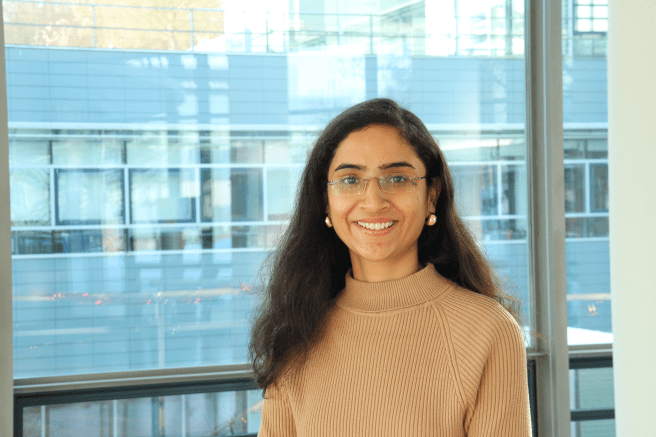
Vani recently joined our group as a PhD in October 2025. She completed her BS-MS dual degree in Earth Sciences from the Indian Institute of Technology Kanpur and will start a PhD project on thermodynamics and maximum power in soil systems. Welcome, Vani!
Hi, my name is Vani Chaturvedi, and I’m from Gwalior, a city in Central India known for its beautiful fort. I got my Bachelor’s and Master’s degree in Earth Sciences with minors in Quantum and Statistical Physics from Indian Institute of Technology Kanpur. I worked as a forecasting analyst in finance industry for about 4 years before joining the PhD programme at the MPI. When I am not in the lab, you will usually find me outside running or playing table tennis.
Education background
In my bachelors program I studied topics in Earth Sciences which includes structural geology, geophysics and geochemistry combined with core courses in physics, chemistry, and mathematics. For my master’s project, I applied remote sensing techniques to classify land use and land cover and analyze changes over time using Google Earth Engine.
During my studies, I developed a keen interest in linking principles of physics with natural processes and thus explored pursuing minors in quantum and statistical physics. I feel fortunate to now pursue this curiosity in my PhD, where I explore how thermodynamic concepts can help us understand microbial life and soil organic matter dynamics.
Research interests
I will start my PhD in the context of a project that aims to apply thermodynamics to the soil, which hopefully will add another constraint from an energy perspective. Most soil models focus on mass balances, tracking how carbon, nutrients, and water move through the system. While this approach has offered important insights, less attention has been given to looking at these processes from an energy perspective, which can provide a deeper understanding of microbial function and soil dynamics.
My research will apply the Maximum Power Principle (MPP), an optimization concept from thermodynamics. The MPP suggests that systems tend to organize themselves to maximize useful work. The BTM group has successfully used this principle to study climate systems—such as the surface energy balance over land —and I am now extending it to soils.
In soil, microbes get energy from plant litter inputs. They use this energy to maintain biomass, produce enzymes that speed up decomposition, and carry out other functions essential for system stability. This creates a feedback loop: faster decomposition changes how much energy is available to microbes. By using a systems perspective guided by MPP, we hope to describe overall energy and matter flows without relying heavily on site-specific parameters, making the results more broadly applicable.
In essence, soil can be thought of as a chemical engine powered by litter-derived energy, sustaining microbial biomass and internal structure while keeping the system away from equilibrium. This approach provides a mechanistic framework for understanding microbial processes and helps estimate energy allocation to functions that are otherwise difficult to measure.
Life in the BTM group and the BGI department
My PhD bridges research interests between the BTM group and the Biogeochemical Integration (BGI) department, co-advised by Thomas Wutzler, Marion Schrumpf (BGI) and Axel Kleidon (BTM). My project is part of the Soil Priority Programme 2322, which allows me to connect with experimentalists, modelers, and chemists working on different aspects of soil systems. I am particularly excited to explore thermodynamic principles that Axel’s group has widely applied in climate systems, now applied to soil energetics.
Contact
Feel free to reach out to me at: vchat [AT] bgc-jena.mpg.de

 Earthsystem.org