Öffentlicher Vortrag: Entropie und Leben – eine planetare Perspektive. Mehr Infos im Blogpost

Am 23. April 2025, 20:00, Rathaus Schöneberg in Berlin halte ich einen Vortrag im Rahmen der Serie „Wissenschaft Live“ der Wilhelm-Foerster Sternwarte. In diesem Blogpost gibt es Links zu Hintergrundinformationen und Videos.

Continue reading “Öffentlicher Vortrag: Entropie und Leben – eine planetare Perspektive. Mehr Infos im Blogpost”

Touring India 2025: A short course in Roorkee, and visits with talks in Gandhinagar, Bombay, and Pune to discuss and interact on entropy and the powers of the Earth system


We were back in India, spending a week at the IIT Roorkee to teach a short course on the Second Law in the Earth System Science, giving talks and having discussions at IIT Gandhinagar, IIT Bombay, IISER Pune and IITM. Find out more on what we did and discussed, look at a few photos, and some related papers in this blogpost.

Continue reading “Touring India 2025: A short course in Roorkee, and visits with talks in Gandhinagar, Bombay, and Pune to discuss and interact on entropy and the powers of the Earth system”

#EGU24: We will be in Vienna to share our updates on thermodynamics, hydrologic sensitivities, biodiversity-climate interactions, temperature extremes and wind energy impacts.

It’s April again, the month when Europe’s largest geoscience union, EGU, convenes for its General Assembly in Vienna, Austria. This year, EGU-24 is scheduled to take place from 14 – 19 April 2024, and we are thrilled to be there and share our science. Our group will be contributing to several presentations, including those by Tejasvi, Sarosh, Axel, Pinhsin and Yinglin.

Continue reading “#EGU24: We will be in Vienna to share our updates on thermodynamics, hydrologic sensitivities, biodiversity-climate interactions, temperature extremes and wind energy impacts.”

Touring India 2024 – Stop 4: Short course and workshop on thermodynamics and optimality of Earth systems at the Islamic University of Science and Technology near Srinagar, Kashmir

Our last stop is Kashmir, where we hold a weeklong workshop on thermodynamics and optimality in climate, water cycle, ecosystems, renewable energy and sustainability. We have intense and stimulating interactions, hands-on sessions organized by Sarosh and Tejasvi, and an excursion into the mountains.

Continue reading “Touring India 2024 – Stop 4: Short course and workshop on thermodynamics and optimality of Earth systems at the Islamic University of Science and Technology near Srinagar, Kashmir”

Touring India 2024 to talk about thermodynamics, climate, renewable energy and sustainability at various places. Stop 1: Delhi

We are back in India again, travelling to Delhi, Aligarh, Kanpur and Kashmir. We will meet good friends and colleagues, interact with students, to talk thermodynamics and Earth system science in seminars, at nice places worth seeing, and in a week-long short course in Kashmir. And we’ll enjoy the company and the good food.

Continue reading “Touring India 2024 to talk about thermodynamics, climate, renewable energy and sustainability at various places. Stop 1: Delhi”

Neu auf Youtube: Kraftwerk Erde – Wie Energie den belebten Planeten prägt.  Jetzt auf Urknall, Weltall und das Leben

Die Erde arbeitet wie ein Kraftwerk und folgt dabei den Hauptsätzen der Thermodynamik. Dabei wandelt sie Sonnenenergie in andere Energiearten um und prägt so die Dynamik des Erdsystem. Allein durch diesen grundlegenden physikalischen Ansatz kann man schon erstaunlich viel vom Erdsystem verstehen, von den Hauptfaktoren, die Temperatur und Wasserkreislauf bestimmen, die Vegetation begrenzen bis zu den Auswirkungen des Klimawandels und den Grenzen erneuerbaren Energien.

Das Video vom Vortrag vom 07. November 2023 vor den Freunden des Planetariums Göttingen ist jetzt auf youtube zu sehen. Auf dem Blog sind die Folien sowie Verweise zu Hintergrundliteratur.

Youtube video: Kraftwerk Erde – wie der belebte Planet Energie umwandelt
Continue reading “Neu auf Youtube: Kraftwerk Erde – Wie Energie den belebten Planeten prägt.  Jetzt auf Urknall, Weltall und das Leben”

#AGU23: Assessing the Impact of Plant Diversity on Terrestrial Climate: Join us at AGU’s fall meeting to explore our poster!

#AGU23 is around the corner!Pinhsin will be there and present her poster on “Plant trait diversity stabilizes climate in a wet and cool state via maximizing terrestrial water recycling” on Thursday, December 14th, 8:30 AM – 12:50 PM PST, in the session “GC41M: The Global Water Cycle: Coupling and Exchanges Between the Ocean, Land, Cryosphere, and Atmosphere I Poster” at MC, Poster Hall A-C – South

Continue reading “#AGU23: Assessing the Impact of Plant Diversity on Terrestrial Climate: Join us at AGU’s fall meeting to explore our poster!”

#EGU23: It’s April again, and Vienna is calling.  We share our recent insights from following the energy through the Earth system. @akleidon @s_ghausi @yinglin_tian

Just like in pre-Corona times, April is the month in which Europe’s largest geosciences union convenes for its General Assembly in Vienna, Austria.  We are excited to be there, present our latest research, and look forward to seeing and talking to you there!

Continue reading “#EGU23: It’s April again, and Vienna is calling.  We share our recent insights from following the energy through the Earth system. @akleidon @s_ghausi @yinglin_tian”

#AGU22: We will be in Chicago next week to present our updates about thermodynamic and energetic controls on land-atmosphere exchange and Arctic sea ice loss events

It is that time of the year again and the AGU Fall Meeting is all set to take place in the hybrid format. This year two members of our lab Sarosh Alam Ghausi and Yinglin Tian will be presenting their research in person at the conference.

Continue reading “#AGU22: We will be in Chicago next week to present our updates about thermodynamic and energetic controls on land-atmosphere exchange and Arctic sea ice loss events”

We’ll be at #EGU22, showing how radiation and maximum power shape temperatures, their extremes, the atmospheric circulation and the wind energy resource. @akleidon @s_ghausi @yinglin_tian

Corona is still around, also in Vienna, but the EGU General Assembly will nevertheless happen again, in a hybrid form. We are thrilled to be there physically, giving our 6 minute short talks on our work, and look forward to seeing and talking to you there!

Continue reading “We’ll be at #EGU22, showing how radiation and maximum power shape temperatures, their extremes, the atmospheric circulation and the wind energy resource. @akleidon @s_ghausi @yinglin_tian”

“Thermodynamics and Optimality of the Biosphere” – online lecture, today, Friday, March 25, at 17:00 Jena time (CET) or 10:00 in Mexico. Interested? You can join too, if you like, here’s the link and background material.

Thermodynamics, entropy and life — does this sound intriguing but also confusing to you? As part of the virtual Spring School on Physics and Mathematics applied to Ecology, organized by Oliver Lopez Corona, I give a lecture where I will cover how thermodynamics applies to the biosphere and the planetary environment, and how it connects to concepts such as the Gaia hypothesis or planetary boundaries. Hopefully, after the lecture, it is clearer to you what entropy is, how it applies to the Earth system, its biosphere, and their interactions. And why it is so important! If you are interested to learn more, this blogpost provides some links to literature mentioned in the lecture.

Continue reading ““Thermodynamics and Optimality of the Biosphere” – online lecture, today, Friday, March 25, at 17:00 Jena time (CET) or 10:00 in Mexico. Interested? You can join too, if you like, here’s the link and background material.”

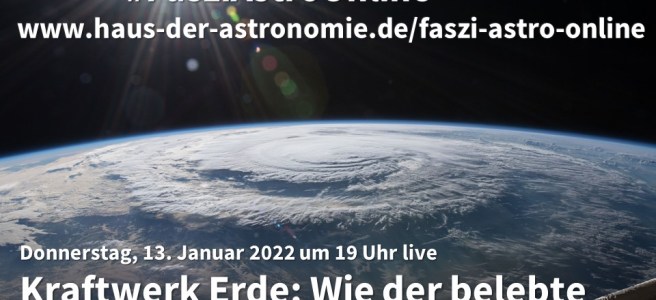
“Kraftwerk Erde: Wie der belebte Planet Energie umwandelt” – Vortrag bei #FasziAstroOnline, heute Abend, 13.01.2022, 19 Uhr, live auf youtube.  Mehr Infos im Blog. @MPI_BGC @HdAstro

Die Erde arbeitet wie ein Kraftwerk, indem sie Sonnenenergie in andere Formen umwandelt, die die Winde der Atmosphäre, den Wasserkreislauf, und auch das Leben und die Menschheit auf der Erde erhalten.  Diese Umwandlungen folgen den Gesetzen der Thermodynamik, die sowohl die Richtung als auch die Grenzen setzt.  Aber Erdsystemprozesse beeinflussen sich auch gegenseitig, sodass man einen Blick auf das Gesamtsystem braucht.  In diesem Vortrag zeige ich, dass man allein durch diesen grundlegenden physikalischen Ansatz schon erstaunlich viel vom Erdsystem verstehen kann – über die fundamentalen Rolle von Energie und Entropie, wie Leben den Planeten verändert, aber auch zu angewandten Themen wie dem Klimawandel und warum die Photovoltaik die Technologie ist, die bei weitem den größten Beitrag zur Energiewende liefern wird.

Continue reading ““Kraftwerk Erde: Wie der belebte Planet Energie umwandelt” – Vortrag bei #FasziAstroOnline, heute Abend, 13.01.2022, 19 Uhr, live auf youtube.  Mehr Infos im Blog. @MPI_BGC @HdAstro”

At #AGU21, we present updates on understanding diurnal temperature variations on land and on deriving precipitation sensitivities from observations using “clear-sky” temperatures and maximum power

Corona has not yet gone away, but the AGU Fall Meeting nevertheless takes place, in a hybrid format. Annu Panwar will be physically there, giving an invited talk on her PhD thesis on diurnal temperature variations (see, e.g., her paper in HESS) and a poster, while Sarosh Alam Ghausi will be giving his poster on precipitation scaling virtually.

Continue reading “At #AGU21, we present updates on understanding diurnal temperature variations on land and on deriving precipitation sensitivities from observations using “clear-sky” temperatures and maximum power”

“Erneuerbare Energien – einfach nachgerechnet” – unser Beitrag zum MINT Festival der @UniJena am Donnerstag.  Hier gibt’s weitere Infos und Links. #moMINTmal21 @MPI_BGC

Wieviel erneuerbare Energie gibt es eigentlich? Reicht sie für die Energiewende in Deutschland?  Die Antworten liefern einfache, physikalisch-basierte Abschätzungen, bei der das Erdsystem im Mittelpunkt steht sowie die Umwandlungen von der Energie im Sonnenlicht in andere Formen. Und dabei steht etwas Physik, genauer gesagt, die Thermodynamik im Mittelpunkt. Das Ergebnis ist nicht ganz so, wie man es vielleicht erwarten würde. Nämlich, dass es zwar jede Menge erneuerbare Energie gibt, aber auch, dass die Nutzung der Solarenergie mit großem Abstand auf Platz 1 liegt, und nicht die Windenergie. Selbst im nicht ganz so sonnigen, aber oft windigen Deutschland. 

Continue reading ““Erneuerbare Energien – einfach nachgerechnet” – unser Beitrag zum MINT Festival der @UniJena am Donnerstag.  Hier gibt’s weitere Infos und Links. #moMINTmal21 @MPI_BGC”

#goldschmidt2021 We contribute our work on dissipative dynamics and frequency distributions in river geochemistry and an update on the thermodynamics of planetary evolution.

Our work on thermodynamics and the Goldschmidt conference on geochemistry – well, that seems like an obvious match. But what we contribute is a little different, and the match is not quite so straightforward. What our perspective adds is (a) a focus on non-equilibrium thermodynamics and disequilibrium, and the processes that generate and dissipate this disequilibrium, and (b) a system‘s view which accounts for the environmental setting as well as the interactions and feedbacks within the Earth as an overarching thermodynamic system. Both of our contributions next week nicely illustrate these points and show how important it is to think „thermodynamics“ beyond its more narrow application to geochemical reactions.

Continue reading “#goldschmidt2021 We contribute our work on dissipative dynamics and frequency distributions in river geochemistry and an update on the thermodynamics of planetary evolution.”

#vEGU21 Next week we’ll present our work on precipitation scaling, diurnal temperature range, offshore wind, and limits to vegetation productivity based on our thermodynamic Earth system view

Thermodynamics rules the world, as well as the science that we present at this year’s EGU General Assembly, which is, alas, virtual rather than in Vienna. It may not be obvious, and our contributions are spread across different sessions. But in the end, we follow the solar energy as it passes through the Earth system, seeking simple, physics-based explanations to simple phenomena: precipitation scaling with temperature found in observations, the diurnal temperature range across regions and vegetation types, also in observations, limits to offshore wind energy in the North sea and what these imply for renewable energy scenarios, and how the really low efficiency of photosynthesis fits to the notion of vegetation being optimal.

Continue reading “#vEGU21 Next week we’ll present our work on precipitation scaling, diurnal temperature range, offshore wind, and limits to vegetation productivity based on our thermodynamic Earth system view”