
As the new year is still young, this is good time to reflect on where we are as a group, with our work on thermodynamics and the relevance of entropy for the Earth system and the energy transition, what we have accomplished in the past year, and what to look forward to in the new year, including short courses, conferences etc that we plan to do. It helps to stay optimistic in these difficult times that we currently face. More in this blogpost.
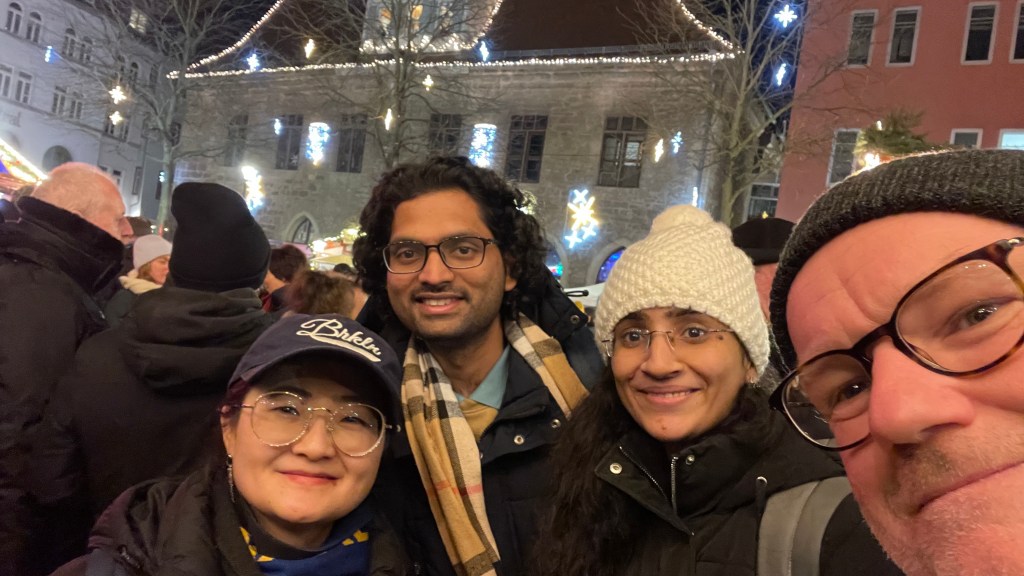
Our group has experienced quite some changes in the last year, quite typical for academia. People come, develop, and go, proceeding in their career, also in our group. Last year, Sarosh left for a faculty position at the Kotak School of Sustainability at the IIT Kanpur in India, Shengjie at the end of the year for a position at the Urban Science Institute of the Chinese Academy of Science. It is sad to see them go, but it was great to have been part of their scientific journey and to see them develop so well. We wish them the best of luck!
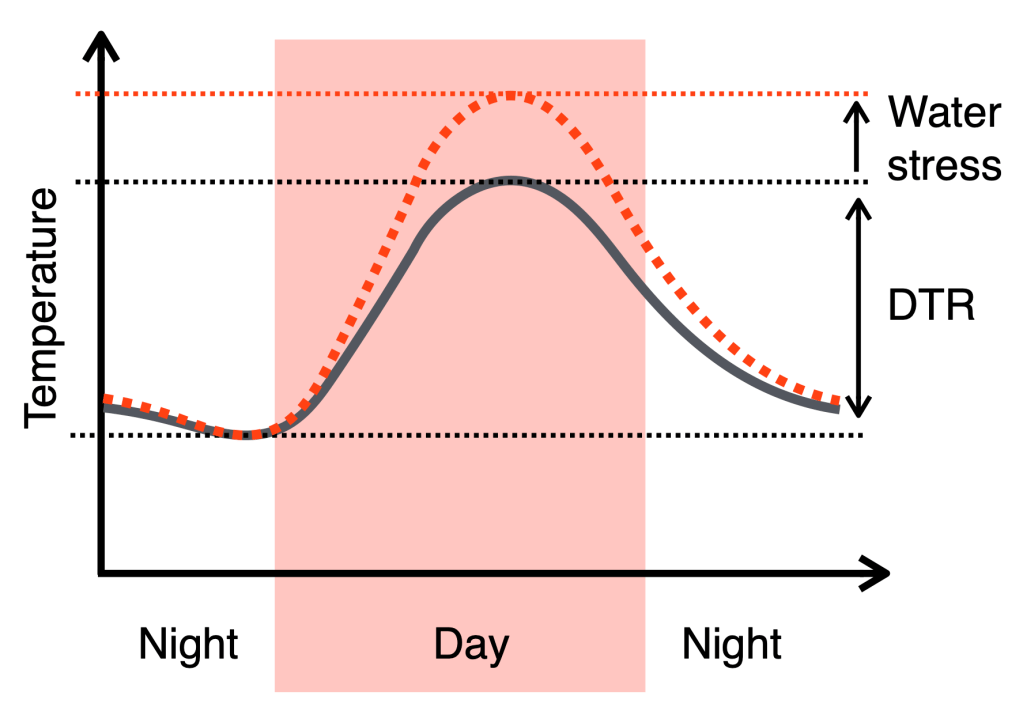
In the last year, we made very nice progress on better understanding the land-atmosphere system in simple, physical terms. Sarosh published a wonderful paper on estimating the diurnal temperature range (DTR) last year in GRL, which explains most of the DTR by heat storage changes in the lower atmosphere (Blogpost), something that we have already explored before in the context of Annu‘s PhD work and picked up some of the formulations from her work.
Based on this DTR work, we have ongoing work to extend this to understand and estimate how relative humidity and the vapor pressure deficit (VPD) develop over the day – again, very basic physics, and surprisingly successful. We also look at the consequences of this work – concretely, in terms of biases in evaporation estimates that use VPD, such as the commonly-used Penman-Monteith approach. On this, Tejasvi has already submitted a manuscript, and this, we hope, will get the impact it deserves. Because it will also affect the interpretation of aridity and its trends.
Jonathan is in the final stage of completing his PhD on wind energy. There will be more about this in a separate blogpost about two papers on offshore wind energy that came out last year. More soon.
And Saurabh applied our max. power approach quite successfully to estimating temperatures across altitudes – that is, in more accessible terms, why mountain regions are typically colder than the lowlands. The answer we found is not commonly in the textbook but makes perfect sense. More explanation will hopefully come soon, in form of a paper that hopefully will be completed very soon.
So there are nice papers already on the way this year – nice, because we feel like we really learned something basic, physical, concrete, and practical from this work about how basic physics shapes climate over land – while thermodynamics and entropy seem so distant and abstract.
With Shengjie, we had discussions on power-law distributions of lakes and cities, and how these relate to dissipative systems and dynamic equations. This was motivated by the work Antonella, Caterina, Roberta and Axel did some time ago, in which we aimed to link the type of distribution to its dissipation, with the hope that we can extend it to other systems (see, e.g., this workshop in the past). Well, this has not quite happened yet. But hopefully, there will be more work on this line of research in the coming year.
We also welcome new members. Vani just started with her PhD – jointly supervised by Thomas Wutzler and Marion Schrumpf, working on thermodynamics, maximum power, and how this may apply to soils. She is funded by a research group that deals with the energetics in soils. We‘ll see where this will take us.
And we have Lucca, Victoria, Stefan and Marie in our group, working on projects related to their Master programmes, mostly related to renewable energy in Germany.

The last year also brought some wonderful highlights, such as our trip to India in March, Axel enjoyed revisiting the thermodynamics of the biosphere through talks and lectures, as well as on thermodynamics and hydrology, in Pisa and for the Boussinesq lecture in Brussels last fall.
There was more science communication on the energy transition, with a very nice paper on entropy and how it shows why combustion is so inefficient, recordings of youtube videos, and even joining a TV science discussion on the energy transition.
What to expect in the new year
So, after all this, what can we look forward to in the new year? Well, sciencewise, there will be more thermodynamics, with some more theoretical work on maximization and precipitation, but also applied work, for instance, on aridity trends.

As in the past years, there will be quite a bit of travel ahead. The first major trip is in March, again to India. We are going to visit Sarosh at IIT Kanpur, hold a short course/workshop on Thermodynamics of the Earth system, and two more events, on the Indian monsoon at the IITM in Pune and on extreme events at IIT Bombay, visiting Subimal Ghosh and colleagues.
This is directly followed at the end of March by a spring school on atmospheric physics, organized by the Environmental Physics section of the German physical society (DPG). There Axel will be giving a lecture on the thermodynamics of the Earth system. If you want to join the school, here is the link to the registration webpage.
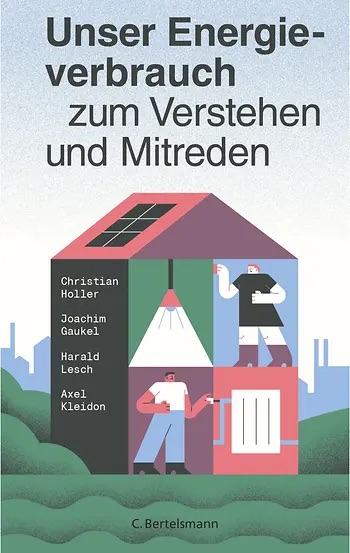
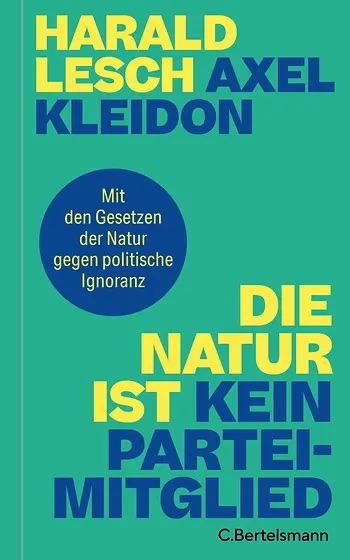
Also in March, two popular science books will be published to which Axel contributed, one on energy consumption, one on energy, climate and politics (both in German). Both are written at the popular level, and both have quite a heavy entropy component to them – after all, this is what the energy transition is about. Which is very satisfying, after all those years, to bring entropy to this level of accessibility! In April, we‘ll have a reception for one of the books in Munich. For the other book, Harald has already organized a joint public reading in a book store in Weimar in June. Certainly novel experiences for Axel, he has neither published popular science books before, nor read publicly.

Then, in May, we‘ll go to the EGU‘s General Assembly in Vienna. Axel will have a solicited talk at the land-atmosphere interactions session, something on thermodynamics and simple physical constraints on the land-atmosphere system. Sarosh submitted our work on vapor pressure deficit, Tejasvi on trends in VPD and atmospheric dryness, Saurabh on elevation-dependent warming trends, and Vani on soil microbes and maximum power. More will follow in a separate post closer to the conference.
Later in May and June Axel will spent some time in Italy again, hopefully working with Antonella and Caterina on dissipation and distributions, and giving lectures at the Univ. of Florence. But these plans still need to be finalized.
And then, in early July, there is a conference organized by GEWEX, a large international science initiative on global energy and water exchanges, on land-atmosphere interactions in Stuttgart. Their goal is to go „back to the drawing board“ on describing the land-atmosphere system. We hope, we can contribute with our maximum power approach and associated physical constraints to stimulating discussions there.
After all of this, it will be time to go on a summer break!

 Earthsystem.org