
Each year geoscientists migrate to Vienna in the spring. Because it is a nice time to meet, and the General Assembly of the European Geosciences Union takes place, this time in early May, from 04 May to 08 May 2026. We are thrilled to be there, meet colleagues and friends, and discuss science. Our group will be involved in quite a few presentations – check out this blogpost for more infos.
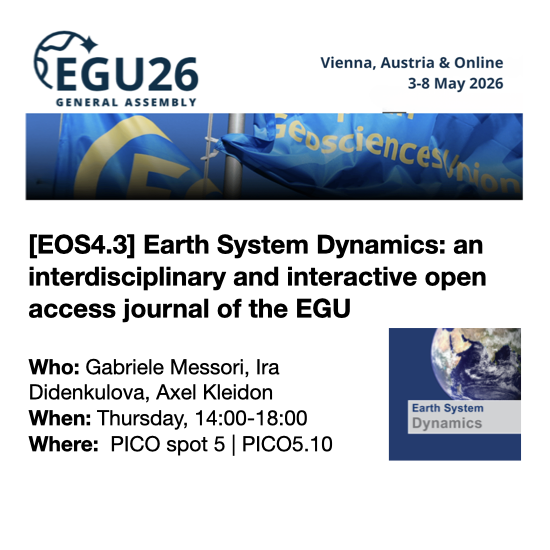
We are heading to Vienna for another year of a fully-packed week of science and meeting people. Apart from the usual sessions, posters, and talks, there are lots of other activities. On Monday over lunch, for instance, there is the regular EGU Plenary – EGU is not just an abstract entity, but an organisation run by people like us. Without the tremendous efforts of some volunteers, EGU meetings, or publications, would not happen. So have a look and see how EGU actually works. Over the whole week, there is also an EGU Publications booth in the Entrance Hall to celebrate 25 years of open access publications – again, the result of volunteer efforts over the years to run and maintain the scientific journals with the support of Copernicus. Axel is involved in EGU publications as well though his role in Earth System Dynamics, so you can find him at this booth on Tuesday morning (11:00 – 12:00), or on Thursday afternoon in the PICO session. Any questions about publishing papers? Just stop by and talk to him!
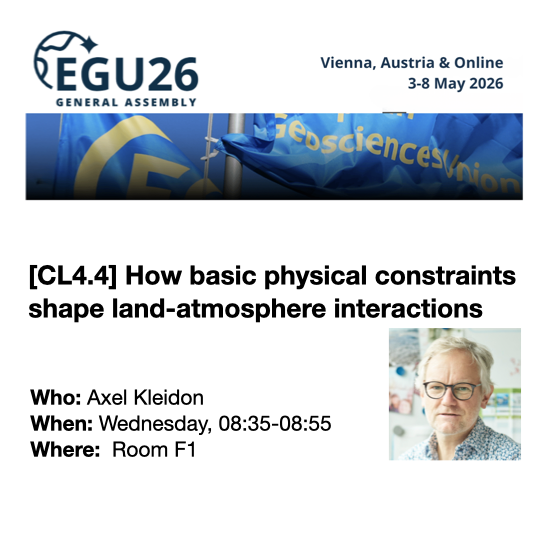

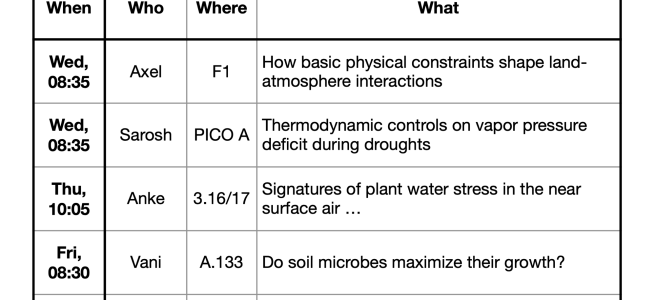
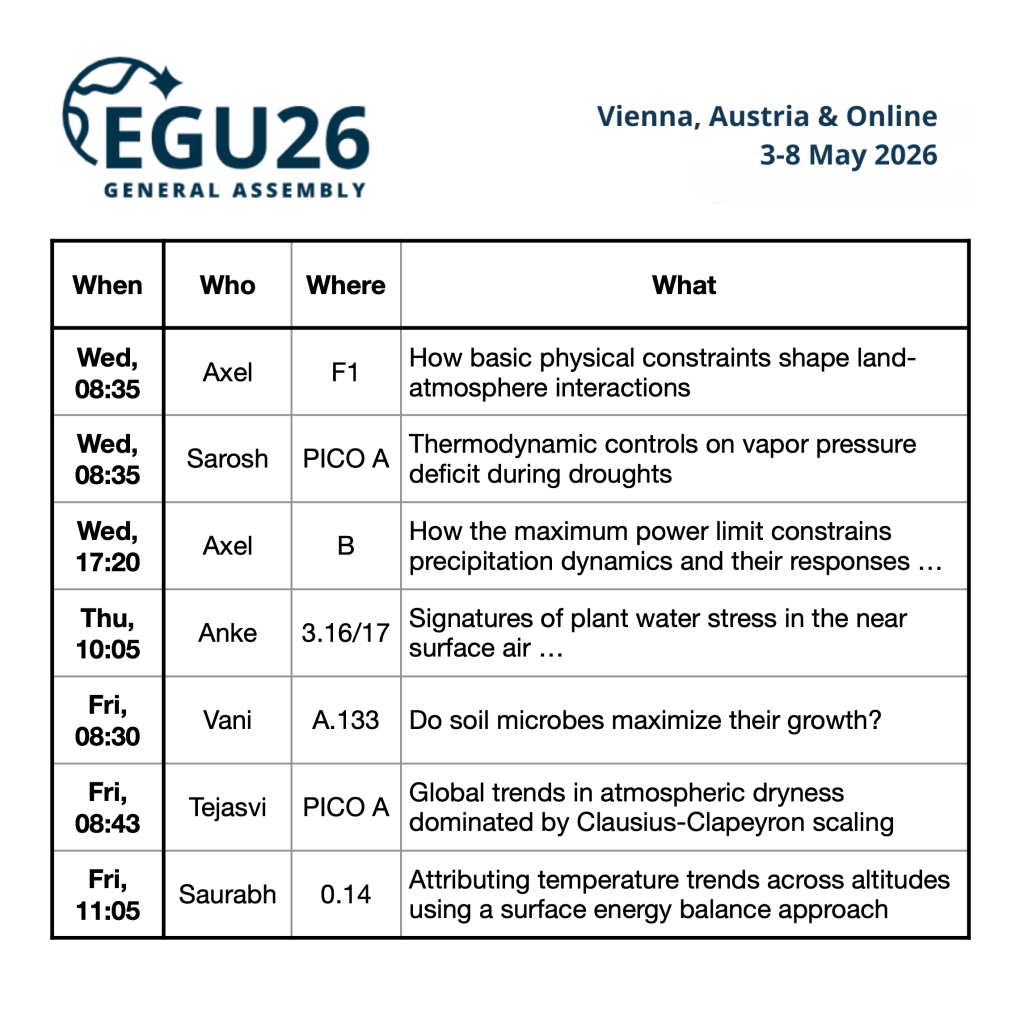
Our science contributions start on Wednesday morning. Axel will then be giving a solicited talk on “How basic physics shapes land-atmosphere interactions” starting at 08:35 in session CL 4.4 in Room F1 (yellow level). His talk is motivated by the central importance of entropy in shaping climate, a topic that is hardly explored. Entropy is central because it limits work. This adds another constraint to climate system functioning in how much work can be done, given the radiative forcing. In the land-atmosphere system, it constrains how much work can be done from the heating of the surface. The resulting maximum power limit then fully determines the partitioning of this heating into cooling by emission and turbulent fluxes in the surface energy balance over land. This approach works very well, as is summarised in this review paper, as shown by the climatological variations across regions in Sarosh’s PNAS paper, and as is also shown by Saurabh’s work along elevation (manuscript in prep.). The focus of the talk is though on the recent work on the diurnal cycle, including the cold heat engine, the diurnal temperature range, and on atmospheric dryness and the water vapour pressure deficit (VPD), a topic on which we have a manuscript in preparation. What this all means? That the climate over land is predominantly shaped by radiation. It points out that interactions and vegetation effects are probably not quite so prevalent as it may at first seem.
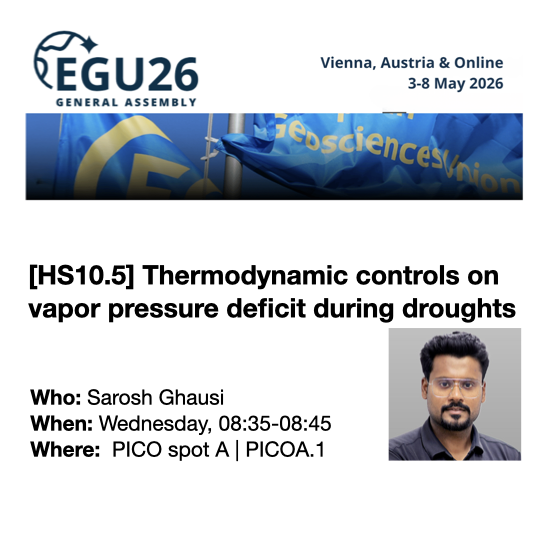
At the same time, Sarosh gives a solicited talk in the PICO session HS10.5 (PICO spot A, red level) on “Thermodynamic controls on vapor pressure deficit during droughts”, also starting at 08:35. He reports on yet unpublished work on understanding VPD variations, which we have shown depend mostly, for good reasons, on the diurnal temperature range. To learn more about it, visit his talk on Wednesday morning.
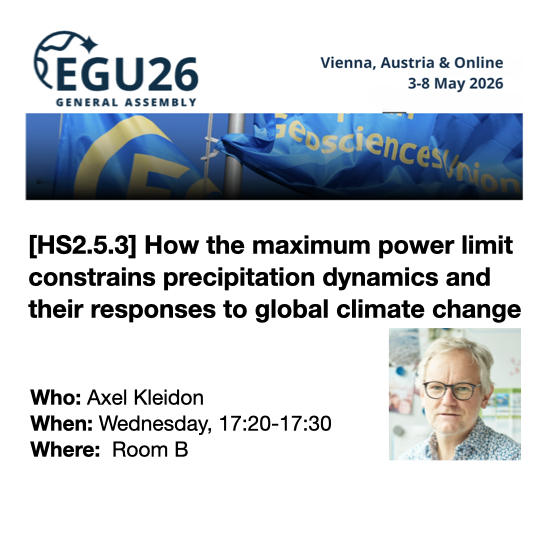
Later on Wednesday afternoon, Axel gives another talk on ongoing work on applying maximum power to precipitation dynamics (yes, because he has one solicited talk, he was also allowed to submit another abstract to EGU…). His talk “How the maximum power limit constrains precipitation dynamics and their responses to global climate change” takes place in session HS 2.5.3 in Room B (red level). So far, we have applied maximum power to surface energy balance partitioning, and also inferred evaporation rates from it (e.g., this paper). But: when moisture condenses and releases heat, this also drives a heat engine. We call it a “moist” heat engine, because it is driven by condensational, rather than radiative heating. And it involves quite different dynamics than the evaporation process, because this condensational heating can amplify with a positive feedback. This description can be implemented into a simple model that can explain quite a few things – from how precipitation changes with global warming up to the scale of the tropical Hadley circulation. More in his talk, and in this translated manuscript that was originally published in German. And, hopefully soon, in a proper paper.
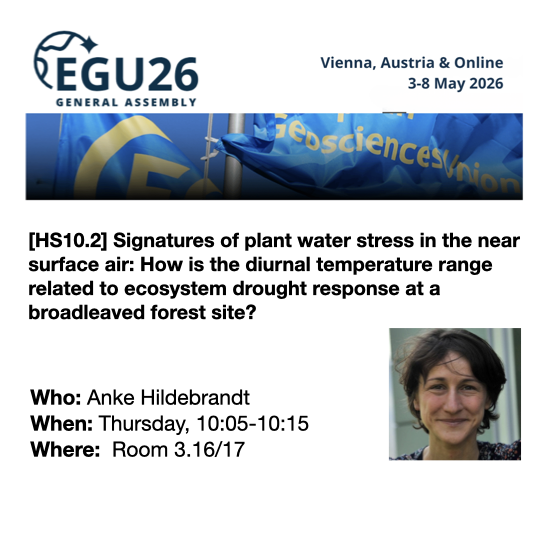
On Thursday, Anke Hildebrandt gives a talk at 10:05 on “Signatures of plant water stress in the near surface air: How is the diurnal temperature range related to ecosystem drought response at a broadleaved forest site?” in session HS 10.2 in Room 3.16/17 (blue level). She used the data her group collected at the Hohes Holz ICOS forest site, tried to apply our approaches to the data to learn more about how one can identify water stress in such weather observations. And for those who don’t know, Anke and Axel are married and often do science together at their kitchen table.
On Friday morning, Vani starts with presenting her poster in Session HS 8.3.4 in the morning from 08:30 to 10:15 in Hall A (Poster A.133). She will be presenting a poster on “Do soil microbes maximize their growth?”. The question is addressed by building upon the Maximum Power Principle (MPP). The principle suggests that biological systems tend to maximize the flux of energy into useful power under given constraints. It is successfully applied in understanding atmospheric processes (see also Axel’s talk on Wednesday or Saurabh’s talk). We hypothesize that soil microbial communities do the same, and also evolve towards a state of maximum growth (power). It will be shown how the soil can be viewed as a thermodynamic dissipative system. A minimal model of soil organic matter dynamics will be used at steady state where the gradient of Gibbs free energy is dissipated by microbes to build the biomass. She will also discuss about different feedbacks that might lead to a maximum in free energy flux to microbial biomass. Please visit by her poster to know more and share your feedback. Feel free to contact her here.
Also on Friday morning, Tejasvi presents in session HS 7.9 at 08:43 at PICO spot A (PICO A.5, red level). His topic on “Global trends in atmospheric dryness dominated by Clausius-Clapeyron scaling” takes the next step on VPD analysis: given the thermodynamic understanding of what controls VPD (as will be discussed in Sarosh’s talk on Wednesday, and also in Axel’s), how do we explain its observed trends under global warming and why do those trends differ so strongly between arid and humid regions?
Building on the same thermodynamic framework, Tejasvi decomposes trends in daily maximum VPD (or, equivalently minimum Relative Humidity, RH) into contributions from three key factors: the Clausius-Clapeyron temperature sensitivity of saturation vapor pressure, the diurnal temperature range, and the nighttime proximity of the atmosphere to saturation, as expressed by the dewpoint temperature. Applying this to long-term observations from FLUXNET and ERA5 reanalysis, he shows that Clausius-Clapeyron scaling is the dominant global driver of atmospheric drying trends. Regional contrasts, however, emerge primarily from differences in nighttime atmospheric dryness, which adds to drying in already arid regions, while dampening it in humid regions, consistent with the “dry-gets-drier, wet-gets-wetter” paradigm. Drop by at this session in case you want to know more and feel free to contact him here.
Saurabh presents in session CL 2.1 at 11:05 in Room 0.14. He will give a talk on “Attributing temperature trends across altitudes using surface energy balance approach“ which is the next step of his previous work on understanding surface temperature means along altitude using the surface energy balance and thermodynamic constraints. The main focus of his talk will be to highlight the distinct drivers that shape the temperature means and trends across altitudes. The temperature means across altitudes are shaped by decreased water vapor greenhouse effect with altitude, while solar heating and hence turbulent cooling (due to maximum power limit) remain fixed. In contrast, the temperature trends are shaped by cooling and warming contributions from different energy balance components. These include increased downwelling longwave radiation across altitudes, as well as differing contributions from absorbed solar radiation, producing a cooling effect at lower altitudes and a warming effect at higher altitudes. At seasonal time scales, the temperature trends and the surface energy balance trends differ significantly for winter and summer time periods. Drop by this session in case you wish to know more, and feel free to contact him here.

 Earthsystem.org