
Vani recently joined our group as a PhD in October 2025. She completed her BS-MS dual degree in Earth Sciences from the Indian Institute of Technology Kanpur and will start a PhD project on thermodynamics and maximum power in soil systems. Welcome, Vani!
Category: PhD work
Welcome 2026: Status of our group, our work on thermodynamics, Earth system science, the energy transition, and our plans ahead

As the new year is still young, this is good time to reflect on where we are as a group, with our work on thermodynamics and the relevance of entropy for the Earth system and the energy transition, what we have accomplished in the past year, and what to look forward to in the new year, including short courses, conferences etc that we plan to do. It helps to stay optimistic in these difficult times that we currently face. More in this blogpost.
Continue reading “Welcome 2026: Status of our group, our work on thermodynamics, Earth system science, the energy transition, and our plans ahead”New PhD position: Using Energy and Optimality to Unearth the Secrets of Soil
Soil might not seem like the flashiest player in the Earth system, but make no mistake – beneath its humble surface lies a complex and dynamic world. It is a critical component of our planet, cycling carbon and nutrients, supporting life, and shaping ecosystems. My research group jointly with colleagues from the Soil Biogeochemistry group at the Max Planck Institute for Biogeochemistry, we are embarking on an exciting new journey: applying thermodynamic principles to soils to better understand their processes, dynamics, and limits. And we are looking for a curious mind to join us as a PhD researcher! More infos in this blogpost.
Continue reading “New PhD position: Using Energy and Optimality to Unearth the Secrets of Soil”New paper: Towards better, simpler, and physically-based estimates of regional wind resource potentials – Testing our KEBA approach with simulations for Kansas
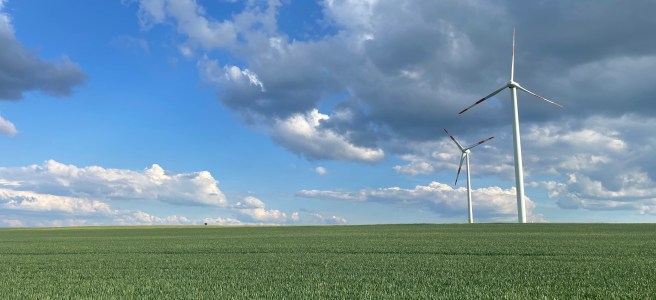
Wind turbines generate electricity by removing kinetic energy from the winds – after all, that is what they are designed to do. The more wind turbines are deployed within a region, the more the wind speeds must be reduced, thereby impacting the wind resource potential of the region. In our new paper we tested our KEBA approach with much more complex numerical weather simulations and found that accounting for the removal of kinetic energy captures the dominant effect, but one also needs to distinguish between daytime and nighttime conditions. This removal effect lowers the resource potential of Kansas by more than 60%, but still yields substantial amounts of electricity – more than Germany currently consumes. More infos in the blogpost and in the paper.
Continue reading “New paper: Towards better, simpler, and physically-based estimates of regional wind resource potentials – Testing our KEBA approach with simulations for Kansas”#AGU22: We will be in Chicago next week to present our updates about thermodynamic and energetic controls on land-atmosphere exchange and Arctic sea ice loss events
It is that time of the year again and the AGU Fall Meeting is all set to take place in the hybrid format. This year two members of our lab Sarosh Alam Ghausi and Yinglin Tian will be presenting their research in person at the conference.
Continue reading “#AGU22: We will be in Chicago next week to present our updates about thermodynamic and energetic controls on land-atmosphere exchange and Arctic sea ice loss events”Can we infer rainfall sensitivity to global warming using observations of precipitation and temperature? Not quite, until you correct for the cooling effects of clouds.
Rainfall events are expected to become heavier as the hydrologic cycle intensifies with global warming. To determine this strengthening, many studies use observed precipitation events and test how these change with observed temperatures. These so-called scaling rates differ from what is expected from theory, showing a decline above temperatures of around 23° – 25°C. This breakdown in scaling makes it difficult to interpret the precipitation response to global warming and its cause further remains unclear. It also raises the question of whether a high-temperature threshold limits the increase in the intensity of precipitation events with temperature. We resolve this in our latest paper by showing that the break in scaling primarily occurs due to radiative effect of clouds on surface temperatures that leads to a covariation between the two variables.
Continue reading “Can we infer rainfall sensitivity to global warming using observations of precipitation and temperature? Not quite, until you correct for the cooling effects of clouds.”How much does evaporation affect temperature variations during the day? That’s what we looked at in a paper just published online in the Journal of Climate. @annuPanwar_sci @ametsoc @MPI_BGC

Over land, there is a marked variation in surface and air temperature during day and night, with the amplitude described by the diurnal temperature range. What are the main factors that determine its magnitude across regions and how much is it shaped by evaporation? This is what Annu Panwar looked at in her last part of her PhD using FluxNet observations and the ERA 5 reanalysis products, with the results just published online in the Journal of Climate. What this analysis shows is that energy balances go a long way to explain the main influences and that evaporation does not have quite such a strong effect as one may think.
Continue reading “How much does evaporation affect temperature variations during the day? That’s what we looked at in a paper just published online in the Journal of Climate. @annuPanwar_sci @ametsoc @MPI_BGC”We’ll be at #EGU22, showing how radiation and maximum power shape temperatures, their extremes, the atmospheric circulation and the wind energy resource. @akleidon @s_ghausi @yinglin_tian
Corona is still around, also in Vienna, but the EGU General Assembly will nevertheless happen again, in a hybrid form. We are thrilled to be there physically, giving our 6 minute short talks on our work, and look forward to seeing and talking to you there!

Last week our group member @annuPanwar_sci successfully defended her PhD thesis on diurnal temperature variations and how they are affected by evaporation and vegetation. Very well done, and congratulations, Annu! @mpibgc

Evaporation cools, right? What may sound so obvious was the topic of Annu’s PhD thesis: to look into observations and find the effects of evaporation in how surface and near-surface air temperatures vary throughout the day. The results are not quite as obvious, and we learned a lot. Here is a brief summary of her thesis, with its contents spread over three papers. Very nice work!
Continue reading “Last week our group member @annuPanwar_sci successfully defended her PhD thesis on diurnal temperature variations and how they are affected by evaporation and vegetation. Very well done, and congratulations, Annu! @mpibgc” Earthsystem.org