How much warmer is the day compared to the night? Or, in other words, how large is the diurnal air temperature range (DTR)? This might seem like a simple question, but the DTR actually varies in surprisingly complex ways across regions and periods. What shapes these variations? What happens to DTR on cloudy days and under clear skies? How does it respond to how wet or dry the land is? And what happens to DTR as the planet warms? We answer these questions in our new study led by Sarosh, published in Geophysical Research Letters. Our goal was to understand the physics behind the DTR using an approach that links the short and long-term variations in DTR to things we can observe and measure, like clouds, sunlight, and surface dryness.
Continue reading “New Article: Explaining observed daily variations and decadal trends in the diurnal air temperature range”Category: Science
Touring India 2025: A short course in Roorkee, and visits with talks in Gandhinagar, Bombay, and Pune to discuss and interact on entropy and the powers of the Earth system
We were back in India, spending a week at the IIT Roorkee to teach a short course on the Second Law in the Earth System Science, giving talks and having discussions at IIT Gandhinagar, IIT Bombay, IISER Pune and IITM. Find out more on what we did and discussed, look at a few photos, and some related papers in this blogpost.
Neues Video: Wie man Muster der globalen Klimaerwärmung allein durch Strahlungstransport verstehen kann
Im neuen Video zum Kraftwerk Erde geht es um den atmosphärischen Treibhauseffekt – speziell, um die Rolle des atmosphärischen Fensters. Über die Faktoren, die die Größe und Durchlässigkeit dieses Fensters beeinflussen, kann man recht einfach, aber physikalisch, direkt Muster der globalen Klimaerwärmung erklären. Im Blogbeitrag gibt es die Referenzen dazu.
Notes from vacation: Thoughts on why climate change impacts in the Alps and Italy are already much more severe than what a 1.5 degree target suggests
We just finished our summer vacation, but that‘s no break from feeling the impacts of global warming. This year we crossed the Austrian Alps and the Appenin mountains in central Italy with our bikes – but where were the ice-covered peaks and why was Italy so hot? Some thoughts on the basic physics involved and why climate change may already be more severe than what some models anticipate.
Continue reading “Notes from vacation: Thoughts on why climate change impacts in the Alps and Italy are already much more severe than what a 1.5 degree target suggests”Touring India 2024 – Stop 3: Workshop and inspiring discussions on sustainable cities, thermodynamics and fractals at IIT Kanpur
Our next stop is at the IIT Kanpur, 400 km east of Delhi at the banks of the Ganges river. Time passes quickly. We spend time preparing lectures, meeting Saurabh – our future new PhD student – and participated in a workshop on sustainable cities. There, we had enlightening discussions on fractals, power laws, and how these relate to thermodynamics and can be applied to cities.
Continue reading “Touring India 2024 – Stop 3: Workshop and inspiring discussions on sustainable cities, thermodynamics and fractals at IIT Kanpur”New paper: Working at the limit – how entropy, work and limits shape Earth system functioning. Here is a simple, but long summary of the key points.
Entropy has intrigued me for a long time – it usually comes up at the very end of asking “why” questions. It is such a fundamental concept in physics, but then – why does nobody talk about it in Earth system science? My review paper just published in Earth System Dynamics explains why entropy is so essential to understand the dynamics of the Earth system: because it limits how much work can be done, and work is at the very core of what we call dynamics.
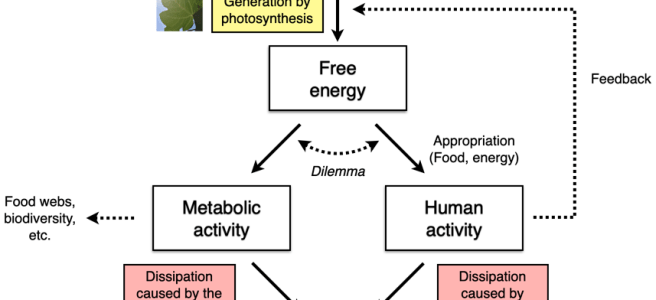
Continue reading “New paper: Working at the limit – how entropy, work and limits shape Earth system functioning. Here is a simple, but long summary of the key points.”New paper: Sustaining the biosphere in the Anthropocene – not as simple as it may sound
Sustainability is a popular topic these days, but what does it actually mean? What does it take to sustain life on Earth in the presence of increased human pressures, and what does it imply for a sustainable future? In a recent paper I combined thermodynamics with an Earth system approach to look at these questions.
Continue reading “New paper: Sustaining the biosphere in the Anthropocene – not as simple as it may sound”New Book Chapter: Understanding the Earth as a Whole System: From the Gaia Hypothesis to Thermodynamic Optimality and Human Societies
“The whole is more than the sum of its parts” – this has been said by smart people throughout human history, from Aristotle to Gibbs. But how does it apply to the vastly complex Earth system? In the book chapter just published I describe how this focus on the whole combined with a thermodynamic formulation of the Earth system including life helps us to understand that the whole is more, and simpler, than the sum of its parts. This is because complex, natural systems appear to work at their thermodynamic limit. The emergent functioning may then very well share characteristics similar to those postulated by the controversial Gaia hypothesis of James Lovelock, which states that life regulates the Earth for its own benefit.
Continue reading “New Book Chapter: Understanding the Earth as a Whole System: From the Gaia Hypothesis to Thermodynamic Optimality and Human Societies”New Blogpost: How much energy will I consume to keep our home warm this winter? A simple estimate, utilizing climate data, gas meter readings, and past gas bills. And yes, the second law comes into play as well.
Winter is coming, snow is falling, and here in Jena we will need gas to heat our homes. Gas prices are at their all-time high, so how much heat do I need and how can I reduce it? I describe a simple, physical way to estimate how much energy I should need to heat our home, and how this can help to find out how effective measures are to reduce energy consumption.
Continue reading “New Blogpost: How much energy will I consume to keep our home warm this winter? A simple estimate, utilizing climate data, gas meter readings, and past gas bills. And yes, the second law comes into play as well.”Can we infer rainfall sensitivity to global warming using observations of precipitation and temperature? Not quite, until you correct for the cooling effects of clouds.
Rainfall events are expected to become heavier as the hydrologic cycle intensifies with global warming. To determine this strengthening, many studies use observed precipitation events and test how these change with observed temperatures. These so-called scaling rates differ from what is expected from theory, showing a decline above temperatures of around 23° – 25°C. This breakdown in scaling makes it difficult to interpret the precipitation response to global warming and its cause further remains unclear. It also raises the question of whether a high-temperature threshold limits the increase in the intensity of precipitation events with temperature. We resolve this in our latest paper by showing that the break in scaling primarily occurs due to radiative effect of clouds on surface temperatures that leads to a covariation between the two variables.
Continue reading “Can we infer rainfall sensitivity to global warming using observations of precipitation and temperature? Not quite, until you correct for the cooling effects of clouds.”How much does evaporation affect temperature variations during the day? That’s what we looked at in a paper just published online in the Journal of Climate. @annuPanwar_sci @ametsoc @MPI_BGC
Over land, there is a marked variation in surface and air temperature during day and night, with the amplitude described by the diurnal temperature range. What are the main factors that determine its magnitude across regions and how much is it shaped by evaporation? This is what Annu Panwar looked at in her last part of her PhD using FluxNet observations and the ERA 5 reanalysis products, with the results just published online in the Journal of Climate. What this analysis shows is that energy balances go a long way to explain the main influences and that evaporation does not have quite such a strong effect as one may think.
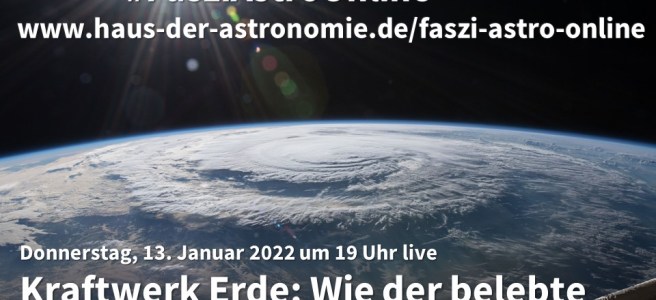
Continue reading “How much does evaporation affect temperature variations during the day? That’s what we looked at in a paper just published online in the Journal of Climate. @annuPanwar_sci @ametsoc @MPI_BGC”“Kraftwerk Erde: Wie der belebte Planet Energie umwandelt” – Vortrag bei #FasziAstroOnline, heute Abend, 13.01.2022, 19 Uhr, live auf youtube. Mehr Infos im Blog. @MPI_BGC @HdAstro
Die Erde arbeitet wie ein Kraftwerk, indem sie Sonnenenergie in andere Formen umwandelt, die die Winde der Atmosphäre, den Wasserkreislauf, und auch das Leben und die Menschheit auf der Erde erhalten. Diese Umwandlungen folgen den Gesetzen der Thermodynamik, die sowohl die Richtung als auch die Grenzen setzt. Aber Erdsystemprozesse beeinflussen sich auch gegenseitig, sodass man einen Blick auf das Gesamtsystem braucht. In diesem Vortrag zeige ich, dass man allein durch diesen grundlegenden physikalischen Ansatz schon erstaunlich viel vom Erdsystem verstehen kann – über die fundamentalen Rolle von Energie und Entropie, wie Leben den Planeten verändert, aber auch zu angewandten Themen wie dem Klimawandel und warum die Photovoltaik die Technologie ist, die bei weitem den größten Beitrag zur Energiewende liefern wird.
Continue reading ““Kraftwerk Erde: Wie der belebte Planet Energie umwandelt” – Vortrag bei #FasziAstroOnline, heute Abend, 13.01.2022, 19 Uhr, live auf youtube. Mehr Infos im Blog. @MPI_BGC @HdAstro”#goldschmidt2021 We contribute our work on dissipative dynamics and frequency distributions in river geochemistry and an update on the thermodynamics of planetary evolution.
Our work on thermodynamics and the Goldschmidt conference on geochemistry – well, that seems like an obvious match. But what we contribute is a little different, and the match is not quite so straightforward. What our perspective adds is (a) a focus on non-equilibrium thermodynamics and disequilibrium, and the processes that generate and dissipate this disequilibrium, and (b) a system‘s view which accounts for the environmental setting as well as the interactions and feedbacks within the Earth as an overarching thermodynamic system. Both of our contributions next week nicely illustrate these points and show how important it is to think „thermodynamics“ beyond its more narrow application to geochemical reactions.
Continue reading “#goldschmidt2021 We contribute our work on dissipative dynamics and frequency distributions in river geochemistry and an update on the thermodynamics of planetary evolution.”If you think surface and air temperature are basically the same thing, think again. Or read our new paper.
In meteorology, air temperature measurements are typically taken 2m above the surface. It is a routine measurement at weather stations, and this temperature is the basis for analyzing trends, such as global warming. The temperature of the surface is not so often measured, but it can be inferred by satellites from how much radiation is being emitted by the surface. Being only 2m apart, one may think that the temperatures basically reflect more or less the same, given their close proximity. We actually found out that this is not the case: surface temperature responds much more strongly to a lack of water than air temperature. This finding was just published in our article in the journal Geophysical Research Letters. Continue reading “If you think surface and air temperature are basically the same thing, think again. Or read our new paper.”
Starting a blog
Why do I start writing a blog? Well, I see a few reasons: Continue reading “Starting a blog”