

On 22nd February 2024, I successfully defended my PhD thesis on “Interactions between hydrological cycle and land-surface temperatures: insights from a thermodynamic systems perspective”. With this, I have finished my joint PhD program at Max Planck Institute for Biogeochemistry and Karlsruhe Institute of technology (KIT). This blog post briefly summarizes my PhD journey from how I chose this topic, the work I did in my PhD, and the implications of my work.
Choosing the topic
It was 2019 and I was pursuing my masters in hydrology at IIT Bombay, India. I had already started doing research on understanding how extreme rainfall and flood events are going to change with global warming (see this GRL paper). It was during this time when Dr. Axel Kleidon was invited to IIT Bombay, gave a talk on “Using thermodynamic limits to infer climate and global climate change”, and I was there in the audience. I had studied thermodynamics before, mostly in my physics and chemistry textbooks but never really realized/thought of how it can be applied to the Earth system. I was aware about its applications on heat-engines and power plants, but what Axel was talking about was to think of the surface-atmosphere system as a heat engine and the hydrological cycle as a dissipative system.
I was extremely intrigued by these concepts and they started to feel more and more obvious once I started to think from that perspective. It was that moment that I decided to work on this topic for my PhD. As it happened, things aligned and a year later I joined Axel’s group at Max Planck Institute for Biogeochemistry as a PhD student. To know more, you can read this blog post “How to get a PhD position at Max Planck Institute”.

My PhD work
The main goal of my Ph.D. thesis was to explicitly account for thermodynamic limits on the surface-atmosphere exchange of heat and water. I tested if the hydrologic cycle operates at this limit and if we can use these limits as additional constraints to quantify the interactions between hydrologic cycling and surface temperature. I also aimed to understand how these interactions play out in shaping surface temperatures over land at different time scales. And what do these interactions tell us about the response of the hydrologic cycle to global warming?
To do this, I visualize the hydrologic cycle in the form of energy fluxes, being converted from one form to another and being transported from one place to another. The laws of thermodynamics set limits and directions to these energy conversions. I account for energetic constraints which include the energy balance at the surface and at the top of the atmosphere. The energy balance constraints are primarily a manifestation of the first law of thermodynamics. In addition to the surface energy balance, I also use the second law of thermodynamics and derive limits to how much maximum work the atmosphere can perform to generate motion for maintaining the transport of heat and mass. This limit is referred to as the “maximum power limit” and the atmospheric processes have been shown to closely operate near this limit (See Kleidon & Renner, 2013; 2017, Conte et al., 2019).
Climatological variation in surface temperatures and turbulent fluxes
In my first study published in PNAS, I test the applicability of this approach to global climate over land. I use it to quantify the dominant physical drivers that shape the climatological variation in surface temperatures and energy partitioning across seasons and across dry and humid regions. I found that the thermodynamic constraints alone can explain more than 95% of the climatological variations in surface temperatures and turbulent fluxes over land. I show that, while the surface energy partitioning into sensible and latent heat is governed by water limitation, the total amount of turbulent flux exchange is predominantly shaped by the local radiative conditions and the ability of the atmosphere to perform work. This implies that reduced evaporative cooling in dry regions is then compensated for by an increased sensible heat flux and buoyancy, which is consistent with observations.
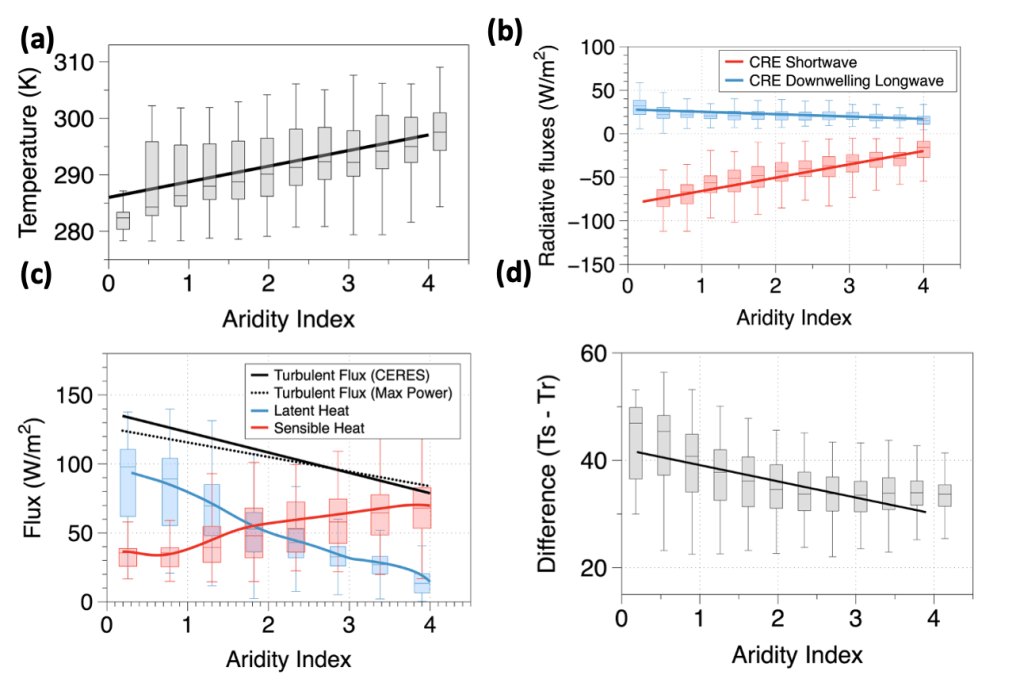
I then showed that dry regions are warmer primarily due to two factors. Firstly, they have less clouds, which increases the surface heating due to solar radiation. Using satellite observations for cloudy and clear-sky conditions, I show that clouds cool the land surface over humid regions by up to 7 K while in arid regions, this effect is absent due to the lack of clouds. The second effect is less trivial: deserts are typically located in the subtropics, where the atmosphere transports heat horizontally through the so-called Hadley circulation. This heat is not added to the surface where it could drive the heat engine for motion, but to the atmosphere above. This makes the power generation process at the surface less efficient, resulting in less cooling and a warmer surface. Heat transport thus reduces the ability of atmosphere to exchange heat and moisture by weakening the heat engine. This weakening is similar to how a hot cup of coffee cools more rapidly on a cooler day compared to a hot day due to the increased temperature difference. In the Earth system, this difference is represented by the surface and atmospheric temperatures which decreases as we go towards drier conditions (Figure 2d). Temperature variations across dry and humid regions are thus mainly mediated through radiative effects. I conclude that radiation and thermodynamic limits are the primary controls on land surface temperatures and turbulent flux exchange which leads to an emergent simplicity in the observed climatological patterns within the complex climate system. To know more about this work, you can read this blog or the press release.
Diurnal temperature range
In my second study, I extend this approach to the diurnal range of air temperatures (DTR). It has been shown that the day-to-day changes in DTR are primarily shaped by the diurnally constrained non-latent energy input into the atmospheric boundary layer (See Panwar et al., 2019; Panwar et al., 2020). I framed a conceptual model combining the energy-balance for the lower atmosphere and explicitly constraining the vertical convective exchange using thermodynamic limit of maximum power. I forced this model with the observations of radiative fluxes and surface evaporative condition and it predicted DTR reasonably well across a range of climates.
This approach captures the response of DTR to changes in radiation, cloud cover, and surface water availability, consistent with FLUXNET observations and ERA-5 reanalysis data. I demonstrate that in addition to strong controls exerted by radiation and cloud cover, DTR also carries imprints of surface-water availability, particularly in the water-limited evaporative regime when the land-atmosphere coupling is strongest. The largest DTR then occurs as a combined result of clear-sky conditions and dry surfaces. This work is currently under review in the journal AGU Advances. I did this work as a part of my three months research stay at Harvard University with Kaighin McColl.
Precipitation-Temperature sensitivities
In my third and fourth study, I evaluated how temperature changes are related to changes in rainfall. This is motivated by the concept of “precipitation-temperature scaling”, a statistical method to obtain the sensitivity of extreme rainfall to temperature from observations. The key idea is that during extreme rainfall events, most of the moisture in the atmospheric column is converted into rain and hence they should scale with the Clausius-Clapeyron scaling of 7%/K. However, observed scaling rates deviate substantially from what is expected from physical arguments (See Utsumi et al., 2011; Bao et al., 2017; Yin et al., 2018; Ghausi & Ghosh 2020). The scaling rates tend to be negative in the tropics and often break down at high-temperature thresholds.
I show that most of the deviations in observed rainfall-temperature (P-T) scaling rates can be explained by the radiative effect of clouds on surface temperatures during rainfall events (what it means is that temperature is not independent of precipitation, because precipitation is associated with clouds, which in turn affects temperatures). I used the thermodynamically constrained energy balance model to remove the confounding radiative effect of clouds on temperatures. I then find a diametric change in precipitation scaling with rates becoming positive and coming closer to the Clausius – Clapeyron scaling rate (7%/K). This explains the apparent discrepancy between the observed negative scaling rates and the projected increase in precipitation extremes by climate models.
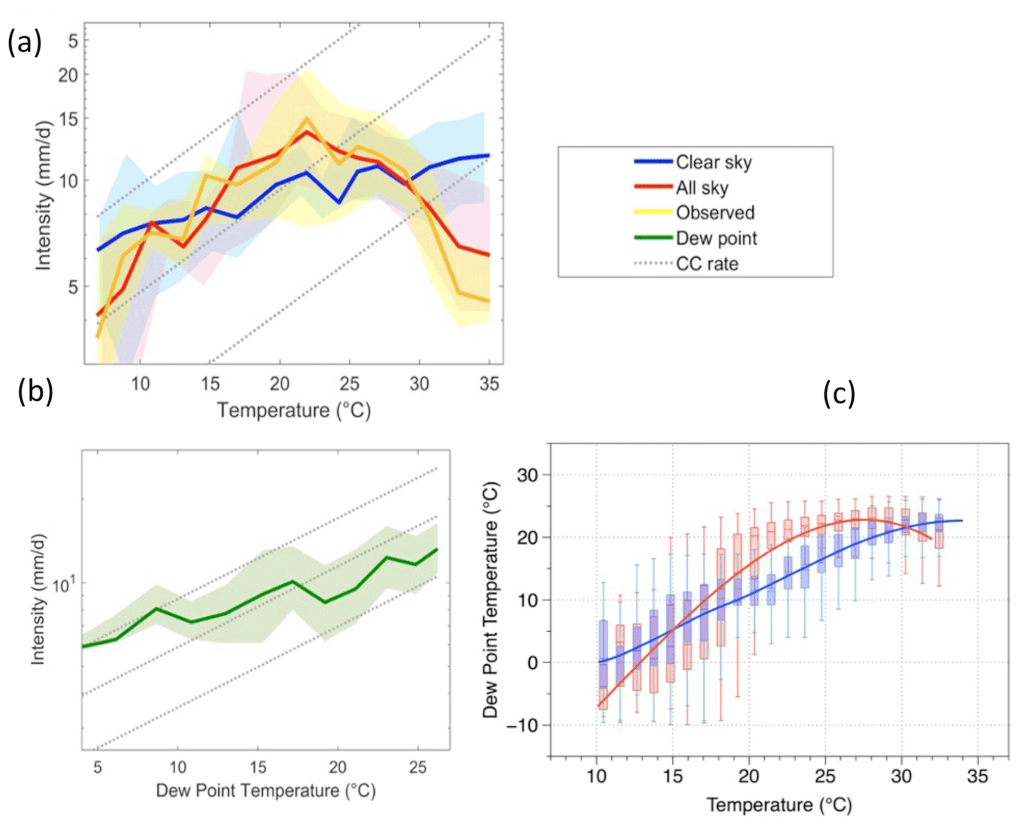
Initially, this study was performed over the Indian monsoon region which experiences strong cloud radiative cooling due to the pronounced seasonal nature of rainfall. This work is already published in the Journal “Hydrology and Earth System Sciences (HESS)”. To know more about this work, you can the read this blog post.
In my fourth study, this hypothesis was extended and evaluated at a global scale and it was confirmed that the negative scaling in the tropics in observed P-T scaling arises mainly due to the cooling effect of clouds.
These findings imply that the intensification of precipitation extremes with warmer temperatures expected with global warming is consistent with observations from tropical regions when the radiative effect of clouds on surface temperatures and the resulting covariation with precipitation is accounted for.
The bigger picture
My findings show that thermodynamic limits impose a relevant and non-trivial constraint on the surface-atmosphere exchange of heat and water which are at present not explicitly considered in climate and land-surface models. This constraint on one hand leads to an emergent predictable pattern in inherently complex turbulent fluxes and surface temperatures across the globe, on the other hand it highlights the relevance of physical constraints in mediating the conditions of the land-atmosphere system, including its many interactions.
This approach can be employed in process-based modelling and reduce the need for empirical parameterizations in land-surface models. It can further contribute in understanding the biases in their estimates. It can also be integrated with the data-driven modelling which relies massively on the availability of data to estimate model parameters. It will be interesting to test if thermodynamic limits can be used to constrain the estimates of these parameters. This approach can further be effectively used to understand and derive the first-order controls of different aspects of global changes and thus contributing to the hierarchy of simple to complex earth-system models to understand climate and global change.
What’s next for me
I am continuing as a postdoc with Axel at the Max Planck Institute for Biogeochemistry from March 1, 2024, working on new projects focused broadly on land-atmosphere interactions, hydrologic sensitivities, temperature extremes and thermodynamics. I will be working as a part of ViTamins project (Invigorating Hydrological Science and Teaching: merging key Legacies with new Concepts and Paradigms).
Finally attached below is the “Thank you” slide from my defense talk. This had been a wonderful journey for me that I will always cherish. But of course, it is just the beginning and I am looking forward to doing a lot more science and hopefully contribute to the society.

PhD Thesis: Ghausi, S. A. (2024). Interactions between the hydrological cycle and land surface temperatures: insights from a thermodynamic systems perspective.DOI: 10.5445/IR/1000169436. https://publikationen.bibliothek.kit.edu/1000169436

 Earthsystem.org