
Vani recently joined our group as a PhD in October 2025. She completed her BS-MS dual degree in Earth Sciences from the Indian Institute of Technology Kanpur and will start a PhD project on thermodynamics and maximum power in soil systems. Welcome, Vani!
Category: Thermodynamics
Welcome 2026: Status of our group, our work on thermodynamics, Earth system science, the energy transition, and our plans ahead

As the new year is still young, this is good time to reflect on where we are as a group, with our work on thermodynamics and the relevance of entropy for the Earth system and the energy transition, what we have accomplished in the past year, and what to look forward to in the new year, including short courses, conferences etc that we plan to do. It helps to stay optimistic in these difficult times that we currently face. More in this blogpost.
Continue reading “Welcome 2026: Status of our group, our work on thermodynamics, Earth system science, the energy transition, and our plans ahead”Stromhunger vs. Klimakrise – Das Energiedilemma: Eine Diskussion in Nanotalk auf 3sat – hier mehr Hintergrund und Links zum „Kraftwerk Erde“

Cool! Ich wurde in die wissenschaftliche Talkshow „Nanotalk“ auf 3sat, einem öffentlich-rechtlichen TV Sender hier in Deutschland, zu Klimawandel und Energiewende eingeladen, zusammen mit Claudia Kemfert und Stefan Thurner. Ausgestrahlt wird sie am Donnerstag Abend um 21:00 auf 3sat, aber jetzt schon als Video online. Wie es dazu kam, wie es war, und eine Sammlung von Links gibt es in diesem Blogpost.
Continue reading “Stromhunger vs. Klimakrise – Das Energiedilemma: Eine Diskussion in Nanotalk auf 3sat – hier mehr Hintergrund und Links zum „Kraftwerk Erde“”Thermodynamics of the Biosphere: A short series of videos

What can we learn from entropy about life on Earth? In this series of videos, I aim to provide the thermodynamic and Earth system background to answer this question. The videos are based on two lectures that I gave in Padova in July 2025. I split the lectures up into an introduction, six questions, and a summary, each in a separate video. This blogpost provides a brief description of the different videos, references for further reading, and the links.
Continue reading “Thermodynamics of the Biosphere: A short series of videos”New Article: Explaining observed daily variations and decadal trends in the diurnal air temperature range

How much warmer is the day compared to the night? Or, in other words, how large is the diurnal air temperature range (DTR)? This might seem like a simple question, but the DTR actually varies in surprisingly complex ways across regions and periods. What shapes these variations? What happens to DTR on cloudy days and under clear skies? How does it respond to how wet or dry the land is? And what happens to DTR as the planet warms? We answer these questions in our new study led by Sarosh, published in Geophysical Research Letters. Our goal was to understand the physics behind the DTR using an approach that links the short and long-term variations in DTR to things we can observe and measure, like clouds, sunlight, and surface dryness.
Continue reading “New Article: Explaining observed daily variations and decadal trends in the diurnal air temperature range”Neu auf Youtube: Was ist dran an der Gaia Hypothese?

Im neuen Video auf Youtube geht es um die Gaia Hypothese, die James Lovelock in den 1970er Jahren formuliert hat. Sie postuliert, dass Leben die planetare Umwelt so verändert und reguliert, dass sie optimal für das Leben ist. Wenn man die Biosphäre als thermodynamisches System betrachtet, welches mit der Erde stark interagiert und dabei ihre Leistung maximiert, ist diese Hypothese gar nicht so abwegig. Mehr Hintergrund in diesem Blogpost.
Continue reading “Neu auf Youtube: Was ist dran an der Gaia Hypothese?”New article: Entropy explains why combustion is so inefficient, why electricity is so much better, and how the energy transition is dramatically increasing efficiency

The new article (original in German) explains the energy transition from a simple but fundamental physical perspective. And something very basic sooner or later leads us to entropy. It helps us understand why electricity-based technologies are much more efficient than those that use combustion and heat as an intermediate step. And why the energy transition is therefore much more of a technical revolution, namely away from heat and towards electricity, with significantly higher efficiency.
Continue reading “New article: Entropy explains why combustion is so inefficient, why electricity is so much better, and how the energy transition is dramatically increasing efficiency”Neuer Artikel: Entropie erklärt, warum Verbrennung so ineffizient ist, es mit Strom soviel besser geht, und wie die Energiewende die Effizienz gewaltig erhöht

Der neue Artikel erklärt die Energiewende aus einfacher, aber grundlegend physikalischer Sicht. Und ganz Grundlegendes, das führt uns früher oder später zur Entropie. Mit ihr versteht man, warum strombasierte Technologien wesentlich effizienter sind als solche, die Verbrennung und Wärme als Zwischenschritt nutzen. Und wieso deshalb die Energiewende einer technischen Revolution gleichkommt, nämlich weg von der Wärme und hin zum Strom, mit erheblich höherer Effizienz.
Continue reading “Neuer Artikel: Entropie erklärt, warum Verbrennung so ineffizient ist, es mit Strom soviel besser geht, und wie die Energiewende die Effizienz gewaltig erhöht”Öffentlicher Vortrag: Entropie und Leben – eine planetare Perspektive. Mehr Infos im Blogpost

Am 23. April 2025, 20:00, Rathaus Schöneberg in Berlin halte ich einen Vortrag im Rahmen der Serie „Wissenschaft Live“ der Wilhelm-Foerster Sternwarte. In diesem Blogpost gibt es Links zu Hintergrundinformationen und Videos.
Continue reading “Öffentlicher Vortrag: Entropie und Leben – eine planetare Perspektive. Mehr Infos im Blogpost”Touring India 2025: A short course in Roorkee, and visits with talks in Gandhinagar, Bombay, and Pune to discuss and interact on entropy and the powers of the Earth system

We were back in India, spending a week at the IIT Roorkee to teach a short course on the Second Law in the Earth System Science, giving talks and having discussions at IIT Gandhinagar, IIT Bombay, IISER Pune and IITM. Find out more on what we did and discussed, look at a few photos, and some related papers in this blogpost.
New PhD position: Using Energy and Optimality to Unearth the Secrets of Soil
Soil might not seem like the flashiest player in the Earth system, but make no mistake – beneath its humble surface lies a complex and dynamic world. It is a critical component of our planet, cycling carbon and nutrients, supporting life, and shaping ecosystems. My research group jointly with colleagues from the Soil Biogeochemistry group at the Max Planck Institute for Biogeochemistry, we are embarking on an exciting new journey: applying thermodynamic principles to soils to better understand their processes, dynamics, and limits. And we are looking for a curious mind to join us as a PhD researcher! More infos in this blogpost.
Continue reading “New PhD position: Using Energy and Optimality to Unearth the Secrets of Soil”New Paper: The Second Law of Thermodynamics, Life and Earth‘s Planetary Machinery Revisited

About 15 years ago I published a paper on “Life, hierarchy, and the thermodynamic machinery of planet Earth”. This paper was quite influential for me as it clarified many things about how the second law of thermodynamics applies to the Earth system. It led to quite a few applications of thermodynamic limits in climate science and renewable energy that worked really well and that I found insightful because it allows us to do climate science in a simple yet physically-based way. The follow-up paper just published provides a summary of this approach and explores potential, more concrete applications of how the biosphere optimizes its form and functioning, and on life on Earth and beyond in general.
Continue reading “New Paper: The Second Law of Thermodynamics, Life and Earth‘s Planetary Machinery Revisited”Workshop on dissipative Earth systems in Firenze in September 2024 … or how the Second Law connects power and dissipation with distributions, structures and information in Earth systems.
The interesting parts of the Earth system are those that perform work, show dynamics, build and maintain structures, deplete gradients, dissipate and produce entropy – in short, dissipative systems. These dissipative systems operate far from the boring state of thermodynamic equilibrium and show interesting behavior, such as well formed structures and power-law scaling. A good topic for a short intro course, because it is one of the lesser known aspects of Earth systems, and a good occasion to meet and talk about. That‘s what we‘ll do in September at the University of Florence in Italy. And to make the topic not quite about everything on Earth, we will focus on hydrogeosystems.
Continue reading “Workshop on dissipative Earth systems in Firenze in September 2024 … or how the Second Law connects power and dissipation with distributions, structures and information in Earth systems.”New article and YouTube videos: How energy and thermodynamics shape the hydrological cycle. And how this can explain more drought and heavy rain with global climate change (translated blogpost)
It only takes a little basic physics to describe the essence of the hydrological cycle. This allows us to reproduce climatological variations and the changes with global climate change very well. It is described in a recently published article (english translation on arXiv) and is explained in two YouTube videos on basics and droughts and on heavy rainfall (in German, but you can use subtitles).
Continue reading “New article and YouTube videos: How energy and thermodynamics shape the hydrological cycle. And how this can explain more drought and heavy rain with global climate change (translated blogpost)”Neuer Artikel und Youtube Video: Wie Energie und Thermodynamik den Wasserkreislauf formt. Und wie dies mehr Trockenheit und Starkregen im globalen Klimawandel erklären kann.
Es braucht nur etwas grundlegende Physik, um das Wesentliche des Wasserkreislaufs zu beschreiben. Damit können wir klimatologische Variationen und die Änderungen mit dem globalen Klimawandel sehr gut wiedergeben. Dies ist im gerade veröffentlichten Aufsatz beschrieben und in diesem Youtube Video erklärt.
Continue reading “Neuer Artikel und Youtube Video: Wie Energie und Thermodynamik den Wasserkreislauf formt. Und wie dies mehr Trockenheit und Starkregen im globalen Klimawandel erklären kann.”Combustion technologies are dead – translated version of my Terra-X blogpost (and yes, it’s because of the entropy)
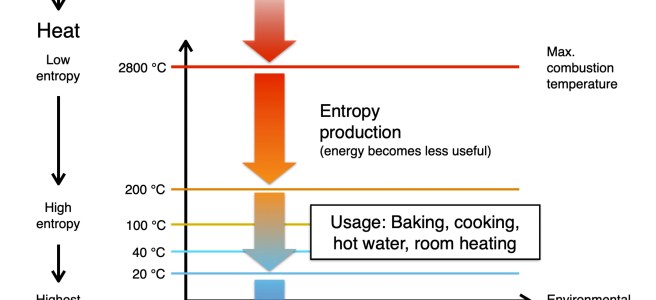
Combustion engines, gas boilers, coal-fired power stations: all these technologies are based on combustion. Physics clearly shows that this is not efficient. We have known for a long time how to do it better. Here the translated (and illustrated) version of my Terra-X blogpost.
Continue reading “Combustion technologies are dead – translated version of my Terra-X blogpost (and yes, it’s because of the entropy)”Neu auf Youtube: Wie der Ansatz vom „Kraftwerk Erde“ einfache, aber physikalisch-basierte Klimaforschung und das Nachrechnen von Temperaturmustern und Trends ermöglicht
In der zweiten Folge der Serie zum Kraftwerk Erde geht es um die Temperaturen der Erde. Thermodynamisch gesehen erzeugen räumliche und zeitliche Unterschiede in der Erwärmung durch Sonnenlicht und der Kühlung durch Abstrahlung ins Weltall Temperaturunterschiede, also Zustände von thermodynamischen Nichtgleichgewicht. Dieses wird vom „Kraftwerk Atmosphäre“ genutzt, um Arbeit zu leisten, Luft zu bewegen, Wärme zu verteilen, und Nichtgleichgewicht abzubauen. Mit Datensätzen vom Strahlungsantrieb und der maximalen Leistung dieses Kraftwerks lässt sich dann wunderbar nachvollziehen, warum Wüsten wärmer sind als Regenwälder, warum sich im globalen Klimawandel Land stärker erwärmt als der Ozean, und warum sich Deutschland in den letzten Dekaden so stark erwärmt hat.
Continue reading “Neu auf Youtube: Wie der Ansatz vom „Kraftwerk Erde“ einfache, aber physikalisch-basierte Klimaforschung und das Nachrechnen von Temperaturmustern und Trends ermöglicht”#EGU24: We will be in Vienna to share our updates on thermodynamics, hydrologic sensitivities, biodiversity-climate interactions, temperature extremes and wind energy impacts.

It’s April again, the month when Europe’s largest geoscience union, EGU, convenes for its General Assembly in Vienna, Austria. This year, EGU-24 is scheduled to take place from 14 – 19 April 2024, and we are thrilled to be there and share our science. Our group will be contributing to several presentations, including those by Tejasvi, Sarosh, Axel, Pinhsin and Yinglin.
Continue reading “#EGU24: We will be in Vienna to share our updates on thermodynamics, hydrologic sensitivities, biodiversity-climate interactions, temperature extremes and wind energy impacts.”Neu auf Youtube: Warum ist Entropie für das Erdsystem so wichtig? Weil es die Leistung begrenzt und damit die Dynamik des Erdsystems.
Entropie und der zweite Hauptsatz der Thermodynamik setzt die Grundlage dafür, wie das Erdsystem aus Sonnenlicht Arbeit erzeugen kann. Die Grundlagen dafür werden in der ersten Folge einer Serie von Videos beschrieben, die das „Kraftwerk Erde“ näher behandelt und die in den nächsten Monaten auf dem Youtube Kanal Urknall, Weltall, und das Leben erscheint.
Continue reading “Neu auf Youtube: Warum ist Entropie für das Erdsystem so wichtig? Weil es die Leistung begrenzt und damit die Dynamik des Erdsystems.”Touring India 2024 – Stop 4: Short course and workshop on thermodynamics and optimality of Earth systems at the Islamic University of Science and Technology near Srinagar, Kashmir

Our last stop is Kashmir, where we hold a weeklong workshop on thermodynamics and optimality in climate, water cycle, ecosystems, renewable energy and sustainability. We have intense and stimulating interactions, hands-on sessions organized by Sarosh and Tejasvi, and an excursion into the mountains.
Continue reading “Touring India 2024 – Stop 4: Short course and workshop on thermodynamics and optimality of Earth systems at the Islamic University of Science and Technology near Srinagar, Kashmir”Touring India 2024 – Stop 2: Visiting Aligarh Muslim University in Aligarh, about 130 km east of Delhi

Our next stop is Aligarh Muslim University – the home and Alma Mater of Sarosh, who just completed his PhD in my group. We visit the campus, talk thermodynamics, meet faculty and Sarosh’s family.
Continue reading “Touring India 2024 – Stop 2: Visiting Aligarh Muslim University in Aligarh, about 130 km east of Delhi”Touring India 2024 to talk about thermodynamics, climate, renewable energy and sustainability at various places. Stop 1: Delhi
We are back in India again, travelling to Delhi, Aligarh, Kanpur and Kashmir. We will meet good friends and colleagues, interact with students, to talk thermodynamics and Earth system science in seminars, at nice places worth seeing, and in a week-long short course in Kashmir. And we’ll enjoy the company and the good food.
Continue reading “Touring India 2024 to talk about thermodynamics, climate, renewable energy and sustainability at various places. Stop 1: Delhi”Neu auf Youtube: Kraftwerk Erde – Wie Energie den belebten Planeten prägt. Jetzt auf Urknall, Weltall und das Leben
Die Erde arbeitet wie ein Kraftwerk und folgt dabei den Hauptsätzen der Thermodynamik. Dabei wandelt sie Sonnenenergie in andere Energiearten um und prägt so die Dynamik des Erdsystem. Allein durch diesen grundlegenden physikalischen Ansatz kann man schon erstaunlich viel vom Erdsystem verstehen, von den Hauptfaktoren, die Temperatur und Wasserkreislauf bestimmen, die Vegetation begrenzen bis zu den Auswirkungen des Klimawandels und den Grenzen erneuerbaren Energien.
Das Video vom Vortrag vom 07. November 2023 vor den Freunden des Planetariums Göttingen ist jetzt auf youtube zu sehen. Auf dem Blog sind die Folien sowie Verweise zu Hintergrundliteratur.
Warum Photovoltaik die Königin der Effizienz ist: mehr Hintergrund und Literaturhinweise zur ZDF Terra-X Kolumne

Photovoltaik ist die Energie der Zukunft – wie ich es kürzlich auf dem Terra-X Blog beschrieben habe. Aber warum? Das kann man recht einfach aus grundlegender Physik erschliessen. Genauer gesagt, es geht um Entropie, und wie sich aus Sonnenlicht am effizientesten Energie gewinnen lässt. Und daraus zeigt sich, dass die Photovoltaik nahezu unschlagbar ist in ihrer Effizienz. Hier gibt‘s mehr Hintergrundinfos und Links zu Literatur.

New paper: Working at the limit – how entropy, work and limits shape Earth system functioning. Here is a simple, but long summary of the key points.
Entropy has intrigued me for a long time – it usually comes up at the very end of asking “why” questions. It is such a fundamental concept in physics, but then – why does nobody talk about it in Earth system science? My review paper just published in Earth System Dynamics explains why entropy is so essential to understand the dynamics of the Earth system: because it limits how much work can be done, and work is at the very core of what we call dynamics.
Continue reading “New paper: Working at the limit – how entropy, work and limits shape Earth system functioning. Here is a simple, but long summary of the key points.”New paper: Sustaining the biosphere in the Anthropocene – not as simple as it may sound
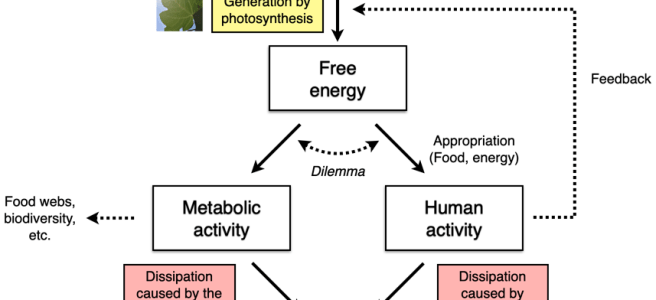
Sustainability is a popular topic these days, but what does it actually mean? What does it take to sustain life on Earth in the presence of increased human pressures, and what does it imply for a sustainable future? In a recent paper I combined thermodynamics with an Earth system approach to look at these questions.
Continue reading “New paper: Sustaining the biosphere in the Anthropocene – not as simple as it may sound”#EGU23: It’s April again, and Vienna is calling. We share our recent insights from following the energy through the Earth system. @akleidon @s_ghausi @yinglin_tian
Just like in pre-Corona times, April is the month in which Europe’s largest geosciences union convenes for its General Assembly in Vienna, Austria. We are excited to be there, present our latest research, and look forward to seeing and talking to you there!

New Book Chapter: Understanding the Earth as a Whole System: From the Gaia Hypothesis to Thermodynamic Optimality and Human Societies

“The whole is more than the sum of its parts” – this has been said by smart people throughout human history, from Aristotle to Gibbs. But how does it apply to the vastly complex Earth system? In the book chapter just published I describe how this focus on the whole combined with a thermodynamic formulation of the Earth system including life helps us to understand that the whole is more, and simpler, than the sum of its parts. This is because complex, natural systems appear to work at their thermodynamic limit. The emergent functioning may then very well share characteristics similar to those postulated by the controversial Gaia hypothesis of James Lovelock, which states that life regulates the Earth for its own benefit.
Continue reading “New Book Chapter: Understanding the Earth as a Whole System: From the Gaia Hypothesis to Thermodynamic Optimality and Human Societies”New Blogpost: How much energy will I consume to keep our home warm this winter? A simple estimate, utilizing climate data, gas meter readings, and past gas bills. And yes, the second law comes into play as well.

Winter is coming, snow is falling, and here in Jena we will need gas to heat our homes. Gas prices are at their all-time high, so how much heat do I need and how can I reduce it? I describe a simple, physical way to estimate how much energy I should need to heat our home, and how this can help to find out how effective measures are to reduce energy consumption.
Continue reading “New Blogpost: How much energy will I consume to keep our home warm this winter? A simple estimate, utilizing climate data, gas meter readings, and past gas bills. And yes, the second law comes into play as well.”#AGU22: We will be in Chicago next week to present our updates about thermodynamic and energetic controls on land-atmosphere exchange and Arctic sea ice loss events
It is that time of the year again and the AGU Fall Meeting is all set to take place in the hybrid format. This year two members of our lab Sarosh Alam Ghausi and Yinglin Tian will be presenting their research in person at the conference.
Continue reading “#AGU22: We will be in Chicago next week to present our updates about thermodynamic and energetic controls on land-atmosphere exchange and Arctic sea ice loss events”Can we infer rainfall sensitivity to global warming using observations of precipitation and temperature? Not quite, until you correct for the cooling effects of clouds.
Rainfall events are expected to become heavier as the hydrologic cycle intensifies with global warming. To determine this strengthening, many studies use observed precipitation events and test how these change with observed temperatures. These so-called scaling rates differ from what is expected from theory, showing a decline above temperatures of around 23° – 25°C. This breakdown in scaling makes it difficult to interpret the precipitation response to global warming and its cause further remains unclear. It also raises the question of whether a high-temperature threshold limits the increase in the intensity of precipitation events with temperature. We resolve this in our latest paper by showing that the break in scaling primarily occurs due to radiative effect of clouds on surface temperatures that leads to a covariation between the two variables.
Continue reading “Can we infer rainfall sensitivity to global warming using observations of precipitation and temperature? Not quite, until you correct for the cooling effects of clouds.”We’ll be at #EGU22, showing how radiation and maximum power shape temperatures, their extremes, the atmospheric circulation and the wind energy resource. @akleidon @s_ghausi @yinglin_tian
Corona is still around, also in Vienna, but the EGU General Assembly will nevertheless happen again, in a hybrid form. We are thrilled to be there physically, giving our 6 minute short talks on our work, and look forward to seeing and talking to you there!

“Thermodynamics and Optimality of the Biosphere” – online lecture, today, Friday, March 25, at 17:00 Jena time (CET) or 10:00 in Mexico. Interested? You can join too, if you like, here’s the link and background material.
Thermodynamics, entropy and life — does this sound intriguing but also confusing to you? As part of the virtual Spring School on Physics and Mathematics applied to Ecology, organized by Oliver Lopez Corona, I give a lecture where I will cover how thermodynamics applies to the biosphere and the planetary environment, and how it connects to concepts such as the Gaia hypothesis or planetary boundaries. Hopefully, after the lecture, it is clearer to you what entropy is, how it applies to the Earth system, its biosphere, and their interactions. And why it is so important! If you are interested to learn more, this blogpost provides some links to literature mentioned in the lecture.
Continue reading ““Thermodynamics and Optimality of the Biosphere” – online lecture, today, Friday, March 25, at 17:00 Jena time (CET) or 10:00 in Mexico. Interested? You can join too, if you like, here’s the link and background material.”Interested in how the Earth system works? I have a #PostDoc opening available in my group, applying thermodynamics, max. power, and optimality to Earth system science. @MPI_BGC
The position is in my research group, which focuses on how the Earth functions as a whole system, the role of life within it, and what a sustainable human future might look like. We take a unique Earth system approach that focuses on thermodynamics, energy conversions, and limits/optimality such as maximum power.
We are seeking a motivated and interested person to help us further develop this approach, evaluate it using observational data, and/or compare it to climate model results. More details are provided in the formal job announcement, which you can find here. More background information in this post.
Continue reading “Interested in how the Earth system works? I have a #PostDoc opening available in my group, applying thermodynamics, max. power, and optimality to Earth system science. @MPI_BGC”“Kraftwerk Erde: Wie der belebte Planet Energie umwandelt” – Vortrag bei #FasziAstroOnline, heute Abend, 13.01.2022, 19 Uhr, live auf youtube. Mehr Infos im Blog. @MPI_BGC @HdAstro
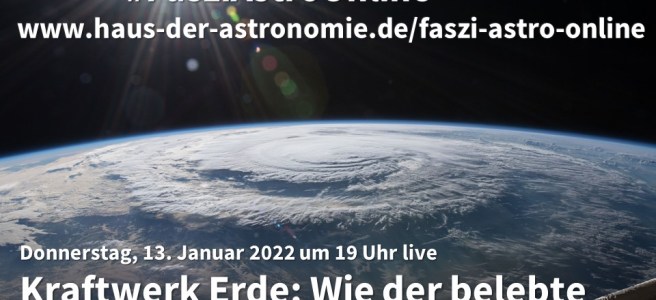
Die Erde arbeitet wie ein Kraftwerk, indem sie Sonnenenergie in andere Formen umwandelt, die die Winde der Atmosphäre, den Wasserkreislauf, und auch das Leben und die Menschheit auf der Erde erhalten. Diese Umwandlungen folgen den Gesetzen der Thermodynamik, die sowohl die Richtung als auch die Grenzen setzt. Aber Erdsystemprozesse beeinflussen sich auch gegenseitig, sodass man einen Blick auf das Gesamtsystem braucht. In diesem Vortrag zeige ich, dass man allein durch diesen grundlegenden physikalischen Ansatz schon erstaunlich viel vom Erdsystem verstehen kann – über die fundamentalen Rolle von Energie und Entropie, wie Leben den Planeten verändert, aber auch zu angewandten Themen wie dem Klimawandel und warum die Photovoltaik die Technologie ist, die bei weitem den größten Beitrag zur Energiewende liefern wird.
Continue reading ““Kraftwerk Erde: Wie der belebte Planet Energie umwandelt” – Vortrag bei #FasziAstroOnline, heute Abend, 13.01.2022, 19 Uhr, live auf youtube. Mehr Infos im Blog. @MPI_BGC @HdAstro”At #AGU21, we present updates on understanding diurnal temperature variations on land and on deriving precipitation sensitivities from observations using “clear-sky” temperatures and maximum power
Corona has not yet gone away, but the AGU Fall Meeting nevertheless takes place, in a hybrid format. Annu Panwar will be physically there, giving an invited talk on her PhD thesis on diurnal temperature variations (see, e.g., her paper in HESS) and a poster, while Sarosh Alam Ghausi will be giving his poster on precipitation scaling virtually.
Continue reading “At #AGU21, we present updates on understanding diurnal temperature variations on land and on deriving precipitation sensitivities from observations using “clear-sky” temperatures and maximum power”Empowering the Earth system with technology: Using thermodynamics to illustrate the possibility of sustained future growth of human societies
Global warming, biodiversity loss, freshwater shortages, food crisis — there are many reasons to think that the planetary future looks rather grim for human societies. Is there any hope that things can turn out well? It is quite hard to remain optimistic, yet when looking at it from basic physics one can find a way forward. In this book chapter that has just been published online I looked at the issue of sustainability and the role of technology using our thermodynamic Earth system approach.
Continue reading “Empowering the Earth system with technology: Using thermodynamics to illustrate the possibility of sustained future growth of human societies”#vEMS21: Our updates on using #thermodynamics for land-atmosphere interactions, the precipitation response to #globalwarming, and the #windenergy potential in the German bight

With summer coming to a close, we are back to present new insights from ongoing research in extreme precipitation events, offshore wind energy and thermodynamics at the European Meteorological Society Annual Meeting 2021. The event, which will be held online next week (6 – 10 September 2021), focuses on weather and climate research and services for the achievement of the UN Sustainable Development Goals. Read on to find out more details about when and what each of us will be presenting.
Continue reading “#vEMS21: Our updates on using #thermodynamics for land-atmosphere interactions, the precipitation response to #globalwarming, and the #windenergy potential in the German bight”#goldschmidt2021 We contribute our work on dissipative dynamics and frequency distributions in river geochemistry and an update on the thermodynamics of planetary evolution.

Our work on thermodynamics and the Goldschmidt conference on geochemistry – well, that seems like an obvious match. But what we contribute is a little different, and the match is not quite so straightforward. What our perspective adds is (a) a focus on non-equilibrium thermodynamics and disequilibrium, and the processes that generate and dissipate this disequilibrium, and (b) a system‘s view which accounts for the environmental setting as well as the interactions and feedbacks within the Earth as an overarching thermodynamic system. Both of our contributions next week nicely illustrate these points and show how important it is to think „thermodynamics“ beyond its more narrow application to geochemical reactions.
Continue reading “#goldschmidt2021 We contribute our work on dissipative dynamics and frequency distributions in river geochemistry and an update on the thermodynamics of planetary evolution.”#vEGU21 Next week we’ll present our work on precipitation scaling, diurnal temperature range, offshore wind, and limits to vegetation productivity based on our thermodynamic Earth system view

Thermodynamics rules the world, as well as the science that we present at this year’s EGU General Assembly, which is, alas, virtual rather than in Vienna. It may not be obvious, and our contributions are spread across different sessions. But in the end, we follow the solar energy as it passes through the Earth system, seeking simple, physics-based explanations to simple phenomena: precipitation scaling with temperature found in observations, the diurnal temperature range across regions and vegetation types, also in observations, limits to offshore wind energy in the North sea and what these imply for renewable energy scenarios, and how the really low efficiency of photosynthesis fits to the notion of vegetation being optimal.
Continue reading “#vEGU21 Next week we’ll present our work on precipitation scaling, diurnal temperature range, offshore wind, and limits to vegetation productivity based on our thermodynamic Earth system view”Why does wind energy become less efficient when used at larger scales? Basic physics explains this effect, starting with a very limited ability of the atmosphere to generate wind energy from radiation, as described in my new review just published.
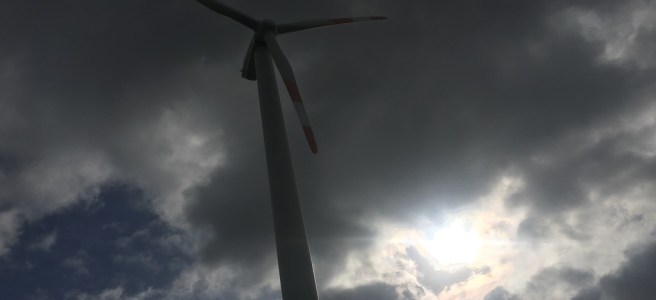
Wind energy plays an important role in the transition to a carbon-neutral, sustainable energy system and is rapidly expanding. So it is a good time to ask how much wind energy there actually is, whether we get close to the limits anytime soon, and why the efficiency of wind energy must decline when used at larger scales. These are basic science questions: How, and why, does the atmosphere actually generate motion, how much does it generate, and how much of it can at most be used? These questions I address in a review paper just published in which I show that it does not take much physics to answer these.
Continue reading “Why does wind energy become less efficient when used at larger scales? Basic physics explains this effect, starting with a very limited ability of the atmosphere to generate wind energy from radiation, as described in my new review just published.”Does thermodynamics limit photosynthesis? It probably does, but not as you may think
 Photosynthesis is the process which powers life on Earth. It takes the energy contained in sunlight, uses carbon dioxide, and generates chemical energy that is stored in form of sugars and similar compounds that fuel the activity of the biosphere, including us humans. And just as any other Earth system process, in doing so it follows the laws of thermodynamics. But does thermodynamics also restrict the efficiency by which photosynthesis can use sunlight?
Starting a blog
Why do I start writing a blog? Well, I see a few reasons: Continue reading “Starting a blog”
 Earthsystem.org